
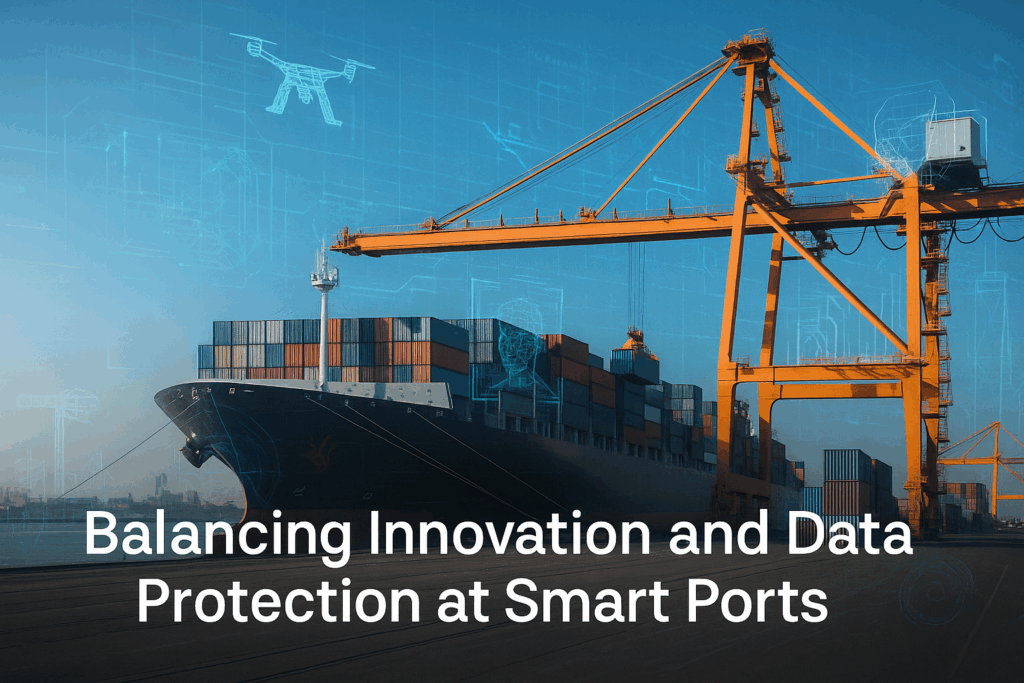
As India’s maritime sector propels itself into a new era of industrial and economic relevance, ports are evolving into smart, sentient ecosystems. The modern Indian port is now expected to do much more than move cargo. It must monitor, analyze, secure, and optimize every inch of its operation — from the gate to the quay, from container stacks to command centres.
This transformation is being fuelled by a convergence of forces: the government’s ambitious port-led development under Sagarmala, a private sector push for performance through automation and digital twins, and an increasingly complex threat landscape that demands intelligent, real-time security systems.
In terminals like Adani Mundra, JNPT, and Vizag Port, this convergence is already underway. Integrated command centers, IP-based surveillance, AI-enhanced gate access, and drone-based patrolling are redefining how security is perceived — from being reactive to becoming predictive and embedded.
But this leap also raises vital questions. What does cybersecurity mean in a world of connected cranes, biometric scanners, and port-wide IoT meshes? And how can India learn from the global smart terminal movement while crafting its own resilient, regulatory-conscious pathway?
Let us explore how cutting-edge security technologies, global benchmarks, and the growing role of automation heads are shaping the secure ports of the future.
What Makes a Port “Smart”? Reframing the Narrative
To understand the transformation of modern ports, one must step beyond the oversimplified notion of automation or digitalization. A truly smart port is not just equipped with gadgets — it is guided by a strategic architecture that reimagines its very purpose: to be faster, safer, cleaner, and more predictive in a volatile world.
Academia and industry alike have attempted to capture this transformation. Among the most comprehensive efforts is the Smart Port Index (SPI) — a framework that quantifies a port’s maturity across four foundational domains: operations, energy, environment, and security. These aren’t silos; they are interlinked levers of performance that together define what it means to be smart in the 21st-century maritime landscape.
In India, where ports are grappling with the dual pressures of global competition and regulatory evolution, this model offers a compelling benchmark. From Vizag to Mundra, we are beginning to see ports align themselves with these four pillars — not as a trend, but as a necessity.
Operations is the first frontier. Smart terminals are increasingly defined by their ability to sense and respond — whether through automated gate access systems, GPS-based yard vehicle tracking, or AI-optimized berth planning. The goal is not simply efficiency but resilience — the ability to adapt to surges in cargo, last-minute vessel arrivals, and disruptive weather events.
The second pillar is energy — often overlooked but vital. With energy costs rising and ESG mandates tightening, ports must act as both consumers and producers of sustainable power. At ports like the one over here at Vizag, The vizag port , solar grids are already supporting lighting and infrastructure. In the port of Rotterdam and LA, wind turbines power cranes and terminal equipment. The shift from passive consumption to energy intelligence is well underway.
Next comes environmental stewardship — not as a CSR checkbox, but as a strategic imperative. Air quality monitors, smart wastewater systems, and low-noise zones are becoming embedded features of modern terminals. Ports must demonstrate not just compliance, but proactive mitigation of environmental harm — especially in coastal cities where public scrutiny is high.
Finally, and perhaps most critically, is safety and security. Here, the evolution is rapid and multi-dimensional. Ports are no longer content with cameras and fences. They are deploying AI-powered surveillance, behavioral analytics, biometric access control, and cybersecurity fortification — creating layered defenses that adapt in real time. The modern security infrastructure must think, learn, and evolve — mirroring the dynamic threats it faces.
Together, these four pillars don’t just define a smart port — they define a smart security culture, one where data, decision-making, and digital confidence converge. For Indian ports, this is not a theoretical model; it is a strategic compass. Those who adopt it early, not just as a checklist but as an operating philosophy, will be the ones who redefine India’s maritime narrative for the decade ahead.
Global Lessons from Tech-First Ports: Where Innovation Meets Security
Across the world, a quiet revolution is underway along the waterfronts of the most advanced ports. These aren’t just bustling trade terminals anymore — they are complex digital ecosystems, layered with real-time intelligence, algorithmic decision-making, and security systems that rival those of smart cities. For Indian ports eyeing the future, these global case studies offer both inspiration and caution.
Singapore’s Maritime & Port Authority (MPA) is often cited as the gold standard. In recent years, it has reimagined port security through mobile command systems, autonomous drone surveillance, and real-time vessel traffic monitoring — all woven together via a port-wide wireless mesh. A 4G-enabled communication backbone allows remote patrols, live streaming from patrol vessels, and even crowd detection analytics. In the video “Securing the World’s Busiest Port”, the command centre’s orchestration is striking: not only does it track everything that moves, but it learns from patterns — anticipating anomalies before they escalate.
In Rotterdam, Europe’s busiest port, the vision goes even further. The Port of Rotterdam Authority has collaborated with IBM and Cisco to build a predictive port platform — using digital twins to simulate port operations, AI to model congestion risk, and IoT sensors to monitor quay walls, infrastructure stress, and suspicious behavior. One of the most telling showcases reveals how even the weather is factored into vessel routing and berth assignment — blending security, logistics, and environmental data into a unified decision engine.
Across the Atlantic, the Port of Los Angeles has embraced the ethos of “fusion intelligence”. Its Cyber Resilience Center exemplifies the convergence of cybersecurity and physical infrastructure, creating a shared-data platform across terminal operators, customs, and homeland security agencies. It is a critical step forward, especially at a time when ransomware, GPS spoofing, and supply chain sabotage are emerging as potent threats in the maritime domain.
Hamburg offers another instructive model, especially in terms of sustainability-linked security. Its smart energy grid powers not only operational infrastructure but also supports sensors, cameras, and control systems. Here, surveillance systems are increasingly AI-powered — able to distinguish between standard activity and behavioral anomalies, whether it’s a crew member crossing a geofence at an odd hour or an unattended container triggering a risk flag.
Even smaller European ports are innovating. Valencia’s smart port project integrates a blockchain-based cargo ledger with an intelligent port perimeter system — enabling tamper-proof audit trails and automated incident response if cargo deviations occur.
What Do These Global Examples Reveal?
The underlying pattern is clear: security is no longer a standalone layer; it is embedded within the very fabric of port operations. AI, machine vision, and automation are being deployed not as flashy add-ons, but as critical infrastructure — essential for maintaining uptime, ensuring compliance, and preventing threats that grow more complex by the day.
Yet, for all their technological prowess, these ports also recognize a sobering truth: trust must be built alongside tech. Whether it’s addressing algorithmic bias in facial recognition, creating consent-driven data frameworks, or preparing for cyberattacks on OT networks — the world’s leading ports are learning that digital transformation without governance is simply automation without accountability.
India’s Leap: Vizag, Mundra, and the Localization of Smart Security
India’s ports are at a pivotal crossroads — moving from industrial-scale legacy systems to intelligent, tech-infused terminals that reflect the country’s broader digital ambition. This transition is not just aspirational; it is strategic. With the government’s Sagarmala initiative laying the foundation for infrastructure upgrades and private players investing heavily in automation, Indian ports are beginning to assert themselves on the global smart port map — with security at the very core.
At the forefront of this transformation is Adani Mundra Port, the country’s largest commercial port by cargo volume. Once seen as a logistics powerhouse, Mundra is now becoming a case study in security automation. Its integration of facial recognition for access control, cloud-based surveillance analytics, and remote control room monitoring demonstrates how Indian private-sector ports are not just adopting technology, but internalizing it as a layer of strategic control. Here, security is no longer a backend cost — it’s a differentiator for efficiency, resilience, and trust.
In Visakhapatnam Port, a parallel journey is unfolding — but with a public-sector lens. The deployment of advanced container scanners, transition to IP-based camera networks, and development of control room dashboards with real-time alert systems reflects a growing appetite for visibility and operational coherence. While legacy systems still exist, the ambition is unmistakable: to move from reactive incident handling to predictive risk mitigation.
Crucially, what makes India’s evolution unique is its context. Unlike ports in Europe or the Pacific Rim, Indian ports often manage diverse cargo profiles, legacy workforce systems, and tight regulatory intersections. This means that security cannot be a one-size-fits-all model. It must be adaptive, context-aware, and layered across physical, digital, and human interfaces.
Moreover, Indian ports are learning to localize global innovation. Instead of importing expensive proprietary solutions, there’s a growing trend of in-house automation labs, regional tech partnerships, and indigenous startups offering AI-based surveillance, biometric edge devices, and incident management platforms tailored to Indian needs.
This shift is also cultural. In the past, many port security systems were designed with a “gatekeeper mindset” — perimeter-based, reactive, and fragmented. Today, forward-looking ports are cultivating a platform mindset — where surveillance, access control, incident logs, crew analytics, and asset monitoring all converge into unified command centers. This is a significant departure, and it’s one that India is increasingly embracing.
But challenges remain. Integration across departments, managing large-scale data in non-cloud environments, vendor lock-ins, and evolving cybersecurity laws all pose friction points. Yet the trajectory is unmistakable: India’s ports are building a new grammar of security — one that is intelligent, contextual, and future-ready.
In a landscape where minutes can cost millions and reputations can turn on a single breach, smart security is no longer a luxury. For Indian ports, it is fast becoming the currency of operational credibility.
The Tech Beneath the Transformation: Chips, Optics, and AI
The most visible part of port security may be the high-definition dome cameras, access control gates, and control room monitors — but the real revolution is happening at the invisible layer. It’s being driven by breakthroughs in semiconductors, optics, and machine intelligence, which together are reshaping how ports perceive, interpret, and respond to risk.
Take the humble surveillance camera, for instance. What was once a passive, analog feed has become a hyper-aware, edge-computing node — powered by AI-capable chipsets like the NVIDIA Jetson Xavier NX or Qualcomm’s Vision Intelligence Platform. These new-generation processors can run deep learning models locally, enabling cameras to detect suspicious behavior, facial anomalies, or even unattended cargo without routing data to a central server.
This rise of edge AI is a game changer for ports, especially in high-traffic environments where latency and bandwidth are critical. A surveillance node at a remote berth can now analyze crowd density, detect loitering, and trigger alerts — all within milliseconds and without depending on network connectivity. In Indian settings where network coverage across sprawling terminals can be inconsistent, such autonomy at the edge becomes a tactical advantage.
Meanwhile, optical technology has made quiet but significant strides. Modern port-grade surveillance systems now feature thermal imaging, infrared fusion, LIDAR overlays, and PTZ (Pan-Tilt-Zoom) auto-tracking powered by AI. These are not just cameras — they’re perception systems. They can distinguish between human and vehicle movement, track objects through smoke or darkness, and compensate for adverse weather conditions — all critical in outdoor maritime environments.
In global ports like Rotterdam and Singapore, the use of multi-spectral imaging and deep vision optics is becoming common in areas like container inspection, yard movement analysis, and even underwater threat detection. Some systems are capable of scanning container numbers, detecting hazardous materials, and matching it with customs databases in near real-time — dramatically reducing manual checks and error rates.
But what ties all of this together is AI — not as a buzzword, but as a decision-making engine. Port authorities are increasingly using:
- Anomaly detection models to flag crew behavior deviations
- Predictive maintenance for gates, cranes, and mobile equipment
- Risk-scoring engines for vessels based on origin, cargo type, and manifest history
- Facial recognition and gait analysis to validate personnel identity in sensitive zones
Where traditional surveillance systems would record, modern AI systems interpret. They don’t just see — they understand. This is what enables a control room operator to go from watching dozens of camera feeds to responding to prioritized alerts generated by smart algorithms. The system becomes a partner, not just a passive observer.
Yet, as with all technologies, these advancements come with a new set of questions. How secure is the firmware inside edge devices? What happens when surveillance data is offloaded to third-party clouds? Can facial recognition systems be manipulated or biased? These are not hypothetical concerns — they’re governance challenges that every modern port must address as part of its digital maturity.
For Indian ports, especially those with ambitions to compete globally, embracing this tech stack isn’t about mimicking the West — it’s about contextualizing innovation. Choosing the right chip, calibrating for coastal optics, training AI models on regional patterns — this is where strategy meets engineering.
As the lines between physical security and digital infrastructure blur, the ports that thrive will be those that invest not only in equipment, but in the understanding of what that equipment enables — a more intelligent, resilient, and responsive security culture.
Cybersecurity, Ethics, and the Surveillance Dilemma
For all the promise that smart ports hold — AI-powered surveillance, biometric access control, predictive algorithms — there lies a growing tension just beneath the surface. The same systems that monitor, optimize, and protect are also capable of surveilling, profiling, and intruding. In the quest for security, ports are now stepping into a grey zone where technology outpaces regulation, and efficiency risks eroding trust.
The challenge is no longer just about managing systems — it’s about governing intelligence.
The Cybersecurity Undercurrent
Smart ports are inherently data-rich. Every access gate, container scan, surveillance camera, and drone feed generates real-time data — often flowing across cloud platforms, vendor networks, and integrated command systems. This hyper-connectivity is a double-edged sword. The more connected the port becomes, the larger its attack surface.
Globally, ports have already faced ransomware attacks, GPS spoofing, and terminal-level intrusions. In India, where cybersecurity laws are evolving, many ports still operate a mix of modern IT and legacy OT (Operational Technology) systems — a combination that is notoriously difficult to secure. A compromised crane PLC or a backdoor in a biometric device could halt operations, leak sensitive cargo data, or worse — open an entry point for wider sabotage.
Port-wide cybersecurity governance is now an imperative. This includes:
- Enforcing zero-trust architecture across connected systems
- Vetting all hardware vendors for firmware integrity and supply-chain risks
- Implementing SIEM (Security Information and Event Management) solutions that unify logs from both physical and digital layers
- Training operational teams on cyber hygiene, not just IT staff
The Biometric Paradox
Biometric systems — facial recognition, iris scans, gait analysis — have become the poster children of modern access control. But they come with complex ethical baggage.
Who owns the biometric data collected at ports? How long is it stored? Is there informed consent? These are not peripheral questions. Under global frameworks like the EU’s General Data Protection Regulation (GDPR) or India’s emerging Digital Personal Data Protection Act (DPDPA), biometric data is classified as sensitive personal information — and mishandling it carries real legal liability.
Moreover, AI systems used for facial analysis can inherit bias — disproportionately flagging individuals based on skin tone, gender expression, or movement patterns that deviate from a model trained elsewhere. When deployed in a security-sensitive environment, these misfires can result in harassment, reputational damage, or operational bottlenecks.
Privacy-by-design is no longer optional. It means:
- Embedding anonymization and data minimization from the start
- Limiting facial recognition zones only to high-security areas
- Ensuring manual override and human-in-the-loop validation
- Publishing transparent policies on data handling and access
Navigating the Surveillance Dilemma
At its heart, this is about trust. As ports scale their surveillance capabilities, they must balance vigilance with accountability. The public — including seafarers, workers, and logistics partners — must know that surveillance exists not to watch them, but to protect them. And when incidents do occur, there must be clear audit trails, grievance mechanisms, and oversight boards to ensure fairness.
Global ports are responding with data ethics councils, impact assessments, and multi-stakeholder advisory panels. Indian ports will need to do the same — not because regulation demands it, but because ethical clarity is fast becoming a competitive advantage in the global trade ecosystem.
A Consultant’s Lens: Five Due Diligence Questions Every Port Should Ask Before Going Smart
Technology has the power to transform — but only when it’s deployed with purpose, foresight, and clarity. In the rush to digitize port operations and fortify security, many organizations leap straight into procurement cycles or pilot deployments without addressing the most critical element: strategic alignment.
As someone who stands at the intersection of operations, automation, and risk, I’ve found that success doesn’t begin with gadgets — it begins with questions. Questions that cut through the buzzwords and anchor the deployment in reality.
Here are five that every port — whether public, private, greenfield, or legacy — must ask before rolling out smart security technologies:
1️ What exactly are we securing — and what does ‘secure’ look like for us?
Ports are sprawling, multi-layered environments. Securing a customs gate is not the same as securing a container yard or a crew entry point. Before deploying technology, leadership must define risk surfaces and security outcomes. Are we trying to prevent intrusion? Reduce theft? Monitor internal compliance? Each goal demands a different configuration of tools, policies, and training.
2️ How will the data flow — and who owns it at every stage?
Surveillance systems today generate massive amounts of data, often stored in hybrid clouds, handled by external vendors, or fed into analytics dashboards. Without clear data governance, ports risk privacy violations, vendor lock-ins, or legal non-compliance. Who owns the facial recognition logs? Who has the right to delete or export incident footage? These are questions that must be answered before systems go live.
3️ Have we audited the hardware — not just the software?
Most cybersecurity audits focus on applications and networks. But in smart ports, the threat often lurks in physical devices: outdated firmware in a thermal camera, hardcoded passwords in access controllers, or rogue USB ports on scanning equipment. A comprehensive hardware threat assessment must become standard — covering everything from biometric terminals to mobile patrol tablets.
4️ Is our security system inclusive — or does it introduce bias or friction?
Facial recognition systems trained on foreign datasets can misidentify Indian faces. AI that flags ‘unusual’ movement may penalize differently-abled staff or night shift workers. A truly smart security system must be inclusive by design — tested across real workforce demographics, audited for fairness, and configured with local cultural context in mind.
5️ What’s our incident response ecosystem — beyond just alert generation?
Too many ports invest in detection, but neglect resolution. A smart camera may raise a red flag — but if there’s no trained response team, escalation protocol, or digital incident log, the tech becomes cosmetic. Smart security must include playbooks, training, war-gaming scenarios, and accountability layers to turn data into action.
When these questions are addressed early, technology deployments become smoother, safer, and far more impactful. They also help ports avoid the common pitfalls of over-purchasing, under-utilization, and reputational risk.
This is where the role of the Automation Head or Security Technology Advisor becomes indispensable — not just to deploy tools, but to design systems that work, scale ethically, and align with both global best practices and local realities.
The Secure Port of 2030: Intelligent, Ethical, and Predictive
The evolution of port security is not just a story of new tools — it’s a paradigm shift. We are witnessing the rise of a new archetype: the intelligent port — one that doesn’t just monitor, but learns; doesn’t just respond, but anticipates; doesn’t just secure assets, but earns trust.
By 2030, ports that lead will not be those with the highest number of cameras or the tallest perimeter walls. They will be the ones that integrate technology with intention, align automation with ethics, and build ecosystems where security is silent, seamless, and strategic.
India, with its demographic depth, growing trade profile, and maturing digital infrastructure, has a unique opportunity to shape this future on its own terms. We don’t have to copy Rotterdam or Singapore — we can leapfrog legacy approaches with home-grown intelligence, contextualized tech, and governance models rooted in our regulatory and operational realities.
But to do this, we must stop treating security as an afterthought or a procurement line item. It must become part of core operational design, right from blueprint to buildout.
Security technologist of tomorrow — will not merely be a gadget gatekeeper. They will be architects of trust, sitting at the crossroads of IT, OT, ethics, and policy. They will need to speak the language of chipsets and cloud security, but also of law, labor, and leadership.
As we move towards this future, the question for every port isn’t just “What tech are we deploying?” — it’s “What culture of security are we building?”
And perhaps the real mark of progress will be this: not how much surveillance we add, but how little we need — because the system has become so intelligent, integrated, and inclusive that risks are managed before they materialize.
