The quiet economics of impossible-wealth scams
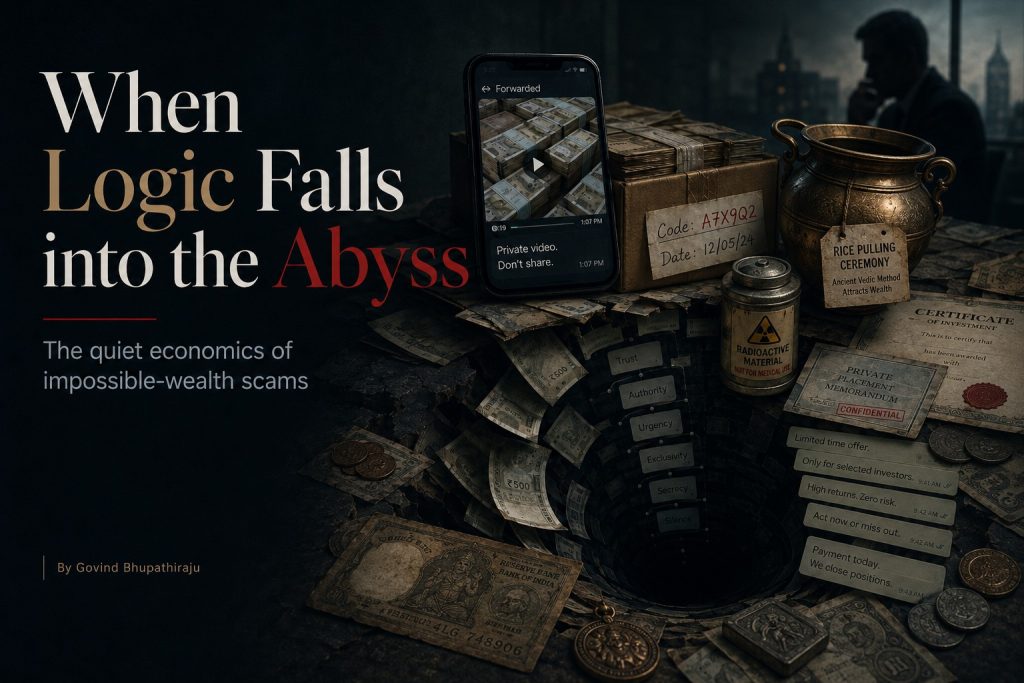
A few days ago, a video reached me through a private channel. It showed stacks of ₹500 notes arranged across several boxes enough cash, at first glance, to fill a room. On one of the boxes sat a small slip of paper carrying a code and a date.
The money was dramatic. The slip was more interesting. In the world of impossible wealth scams, such details are not decoration. They are instruments of persuasion.
I usually write on this site about risk moving through trade routes, shipping lanes, institutions and supply chains the macro layer. This story sits much closer to the ground. Yet the underlying threat model is strikingly similar.
A disinformation campaign and a rice pulling coin racket in Andhra Pradesh may appear worlds apart. But both manufacture urgency. Both borrow authority they do not possess. And both depend on the target failing to ask one disqualifying question early enough.
This is not merely a story about greed.
It is a story about how logic is slowly dismantled.
The architecture of the impossible
Across India, these scams move through WhatsApp groups, brokers, Facebook advertisements and carefully staged introductions.
The object changes.
It may be:
- A so called rice pulling vessel;
- An antique coin;
- A rare currency note;
- A supposed royal artefact;
- A buried treasure;
- An object claimed to contain radioactive or scientific properties.
But beneath the changing surface, the structure remains remarkably stable.
There is always an object said to be worth far more than any normal market would recognise.
There is always a powerful buyer foreign, royal, institutional or government linked.
There is always a certificate, test, clearance or secret procedure.
There is always a fee.
And once that fee is paid, there is always another one.
The victim is not buying an object.
He is buying proximity to a fortune.
That is the real product.
The first transaction is belief
Most frauds of this kind do not begin with a demand for lakhs. They begin with attention. A video arrives. Someone makes an introduction. A broker speaks confidently. A supposedly confidential conversation follows. The target is shown documents, cash, uniformed men, scientific language or claims involving the Reserve Bank of India, customs authorities, foreign buyers or national laboratories. The process is designed to feel too large to be fake and too secret to be independently verified.
At this stage, the scammer does not need the victim’s money. He needs the victim to accept the premise. Once the premise is accepted, money becomes easier. The first fee may be small enough to appear harmless: registration, testing, transport, token payment, verification or documentation. That payment is important for a reason beyond its value. It transforms curiosity into commitment.
After the first payment, the victim is no longer evaluating the opportunity from the outside. He is inside the story. And from inside, the questions begin to change.
The victim no longer asks:
Is this real?
He begins asking:
What must I do to complete it?
That shift is the heart of the fraud.
The case files are no longer anecdotal
These scams recur frequently enough to be treated as a pattern rather than as isolated foolishness. In Andhra Pradesh, police have continued to arrest suspects connected with so called rice pulling vessels usually copper objects claimed to possess extraordinary properties and to attract enormous institutional or foreign interest.
In one reported case from Sri Sathya Sai district, a victim allegedly paid ₹10 lakh in two instalments after being promised access to a copper vessel that could attract rice and supposedly be sold for ₹2 crore. When he sought repayment, the case reportedly escalated into confinement and threats.
The antique coin variant operates through a similar structure.
A person sees an advertisement claiming that an old coin or currency note is worth lakhs or crores. A buyer expresses immediate interest. Then the victim is asked to pay registration fees, taxes, GST, TDS, insurance, transport, RBI charges or clearance expenses.
The promised buyer never pays.
The fees continue.
The production values are improving.
The scam is no longer just a poorly written message from an unknown number. It may involve:
- professional looking Facebook pages;
- influencers;
- forged certificates;
- fake banking interfaces;
- staged video calls;
- police uniforms;
- rooms filled with cash;
- personalised codes and dates.
The more absurd the promised wealth, the more elaborate the theatre required to sustain it.
When a crowd becomes evidence
One of the most powerful tools in these scams is not a document.
It is other people.
Large numbers of potential victims have reportedly travelled to supposed coin exhibitions or buying events after watching videos claiming that old coins could fetch enormous sums.
A crowd creates social proof.
If hundreds of people have come, the opportunity must be real.
If others are paying registration charges, the fee must be normal.
If influencers are discussing it, the market must exist.
But crowds do not validate a proposition.
They merely show that the proposition has travelled.
This matters because misinformation becomes more convincing when it appears to have passed through many hands. The recipient begins to mistake circulation for verification.
A rumour forwarded ten thousand times is still a rumour.
A queue outside a fraudulent event is not evidence of a market.
It is evidence of successful distribution.
The cost is not merely financial
It is tempting to describe these scams as comic or ridiculous.
The language—rice-pulling vessels, secret international buyers, crore-valued coins—almost invites ridicule.
But the consequences can be severe.
Victims may mortgage property, borrow from relatives, liquidate savings or hide payments from their families. When the promised transaction fails, they face not only financial loss but humiliation, fear and coercion.
In one widely reported case, a retired security guard who had paid money to alleged coin-scam operators later died by suicide after the fraud escalated into threats.
That is why this category belongs closer to coercive crime than to harmless superstition.
The fraudster does not merely exploit belief.
He weaponises hope, secrecy and shame.
Why this is not simply gullibility
The most common reaction—especially among professionals trained in security or finance—is:
How could anyone believe this?
That question is understandable.
It is also incomplete.
Victims are not always reckless people chasing easy money. They may be business owners recovering from a setback, retirees worried about declining savings, families facing debt or individuals who believe an inherited object could solve a real financial problem.
The scammer does not present the entire absurd proposition at once.
He builds it in layers.
First, the object is said to be rare.
Then a buyer appears.
Then a valuation.
Then a certificate.
Then a fee.
Then a delay.
Then a final clearance.
Then one last payment.
At every stage, the victim is encouraged to believe that the difficult part is already over.
The fortune is always one step away.
By the time the proposition should collapse under scrutiny, the victim has invested more than money.
He has invested secrecy, expectation, imagination and personal credibility.
To step away now would mean admitting that all of it was false.
That is why many continue.
The mathematics of sunk belief
The mechanism is often described as the sunk-cost fallacy, but in these scams the sunk cost is psychological as much as financial.
After paying ₹10,000, the victim may pay ₹50,000 to protect the first payment.
After paying ₹50,000, he may pay ₹2 lakh to recover the total.
Each new payment is presented as the final barrier.
The fraudster understands that the victim is no longer calculating expected gain rationally. He is trying to avoid confirmed loss.
The psychology becomes inverted.
Instead of asking:
What evidence justifies another payment?
The victim asks:
What if I stop now and lose everything already paid?
The possibility of recovery becomes more emotionally powerful than the probability of further loss.
This is where logic falls into the abyss.
Not in one dramatic moment, but through a sequence of smaller concessions.
Why shame is part of the business model
Fraudsters rely heavily on secrecy. They tell victims that the transaction is confidential.They warn that outsiders will misunderstand. They claim banks or authorities must not be contacted prematurely. They suggest that disclosure could cancel the deal.
But secrecy serves another purpose. It isolates the victim from corrective voices.
A spouse might ask why an institutional buyer needs a personal payment.
A banker might notice unusual transfers.
A lawyer might demand a contract.
A police officer might recognise a known fraud pattern.
The scam survives by keeping those people outside the room.
Then, once the victim begins suspecting fraud, shame takes over.
He delays telling his family.
He avoids the bank.
He waits before approaching police.
He hopes the next call will restore everything.
That delay gives the fraudster time to withdraw, transfer or fragment the money.
Shame is therefore not a side effect.
It is part of the operating model.
The authority mask
Impossible wealth scams rarely present themselves as private bargains between strangers.
They borrow the legitimacy of institutions.
The names change:
- RBI;
- customs;
- income tax;
- scientific laboratories;
- foreign embassies;
- defence agencies;
- international museums;
- major corporations;
- police departments.
The scammer knows that institutional language discourages ordinary questioning.
A certificate looks official.
A uniform creates hesitation.
A technical phrase creates distance.
A government logo creates borrowed trust.
But a genuine institution does not need secrecy, personal advances and WhatsApp brokers to execute a lawful transaction.
This is the contradiction victims must be trained to recognise. The grander the institution being invoked, the less plausible the informal process usually becomes.
The disciplined questions
Cynicism is not enough. Saying “everything is fake” does not create useful judgement. What works better is a fixed set of questions, asked early and literally:
- Why was I selected?
- Why does this require secrecy?
- Why is there urgency?
- Why must I pay before receiving anything?
- Why is no recognised institution directly involved?
- Why is the promised reward so large compared with the entry cost?
- Why is the buyer operating through WhatsApp, Facebook or an unnamed broker?
- Why would a person controlling crores need my money to unlock the transaction?
- Can I independently verify the buyer, institution, certificate and valuation?
- What happens if I refuse to pay today?
A genuine opportunity should survive basic scrutiny.
A scam depends on preventing scrutiny long enough for the first payment to be made. Once the story cannot answer these questions, it is no longer an opportunity under evaluation……….It is a loss in progress.
The single most useful question
Among all the warning signs, one question does more work than the others:
Why does someone who controls enormous wealth need money from me?
A buyer offering crores should not need the seller to fund registration, taxation, insurance, clearance or testing through personal transfers.
A foreign institution should not depend on a broker’s UPI account.
A government-linked process should not operate through disappearing WhatsApp numbers.
A wealthy buyer does not need the poorer party to finance the purchase.
The moment that contradiction appears, the entire structure should fail.
But fraud works by surrounding that contradiction with so much theatre that the victim stops looking directly at it.
If the money has already been paid
The first response should be containment, not humiliation. Families often lose valuable time by arguing about how the victim could have believed the story. That conversation can wait.
The immediate priorities are:
- stop all further payments;
- preserve messages, numbers, screenshots, emails and transaction records;
- contact the bank or payment provider immediately;
- report the transaction through the national cybercrime helpline;
- approach local police where threats, confinement or coercion are involved;
- do not negotiate privately with the fraudster;
- do not pay a so-called recovery agent who promises to retrieve the money for another fee.
Victims should also be warned about secondary fraud. Once someone is identified as having paid into one scam, he may be approached by another person claiming to be a police official, lawyer, hacker or recovery specialist.
The second scam offers to recover the first loss.
For a fee.
The responsibility of the receiver
Not everyone who receives these videos becomes a victim. But every casual forward strengthens the ecosystem.
A video sent by a stranger is suspicious. The same video sent by a friend, relative or respected professional carries borrowed credibility. That is precisely why such clips travel through private networks. Trust is being used as infrastructure. Before forwarding footage of cash, rare coins, miracle vessels or secret buyers, ask what function the forward serves.
Does it inform?
Or does it add legitimacy to a claim that has not been verified?
Even altering or adding a date, code or handwritten slip “as a favour” can help manufacture false authenticity.
In such scams, the people who distribute the evidence may not know they are participating in the fraud.
But their relationships provide the distribution system.
The same vulnerability at every scale
There is a wider security lesson here.
I have written before about institutional resilience and the risks created when systems rely too heavily on assumed trust. The same principle applies here.
At the national level, disinformation campaigns imitate journalism, authority and public consensus.
At the organisational level, attackers impersonate executives, vendors or trusted systems.
At the individual level, impossible-wealth scams imitate banks, police, scientific bodies and wealthy buyers.
The costume changes.
The vulnerability does not.
In every case, the attacker asks the target to trust the appearance of authority rather than verify the underlying process. The failure is rarely a complete absence of security. It is security applied too late.
When logic falls
The door in these stories never opens directly onto disaster.
It opens onto possibility.
Behind it is a buyer.
Then a certificate.
Then a fee.
Then a delay.
Then another floor below.
The descent is gradual enough that each step feels recoverable. By the time the victim understands that there was never a fortune at the bottom, he may have travelled too far to admit how the journey began. That is the quiet economics of impossible wealth. The scammer sells no real asset. He sells hope in instalments. And the only reliable defence is to ask the disqualifying question before making the first payment not after logic has already fallen into the abyss.