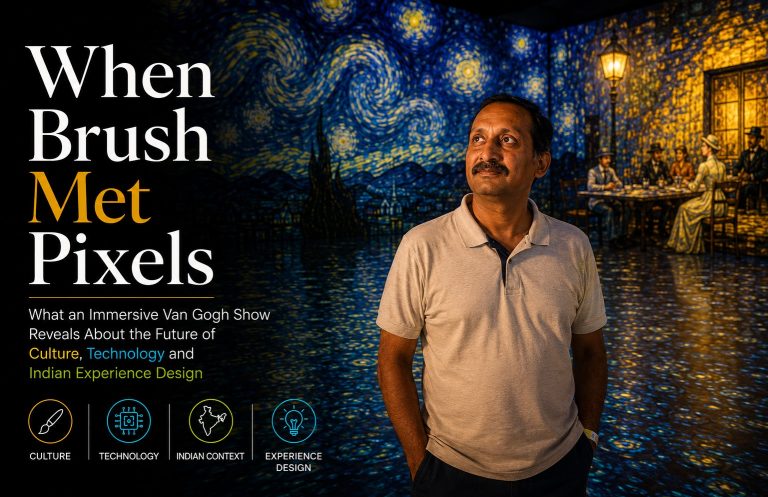
There are moments when an outing becomes more than an outing. My visit to the immersive Van Gogh experience in Pune began as a curious encounter with digital art. It ended as something larger – a question.
I have always been a skeptic of “the crowd.” There is a particular friction that comes with popular events: the noise, the jostling, the urgency to document everything, the performative nature of modern leisure. So when I stepped into the immersive world of Van Gogh, I arrived with a healthy dose of doubt. Could one truly immerse oneself in the world of a 19th century painter while surrounded by the hum of the 21st century?
My interest was not purely artistic. It was also technical, cultural and entrepreneurial. I wanted to understand how technology acts as a bridge or a barrier between the soul of a painter and the eyes of a modern audience. What I discovered was more layered than expected.
Have Our Eyes Changed?
As the digital projections unfolded around me, one realization stayed with me: our eyes have changed. We are a generation calibrated by 4K and 8K screens, cinematic filters, AMOLED displays and algorithmically enhanced beauty. We no longer merely look at images. We expect them to glow, move, surround and overwhelm us.
Inside the immersive space, Van Gogh’s yellows seemed brighter, his blues deeper, his skies more restless. The colours were magnificent, perhaps more vivid than the paintings as they exist today on museum walls. But this magnificence carries a quiet dilemma. When technology can blast a “perfect” yellow across a room, do we still have the patience for the layered complexity of a physical brushstroke? When a projection can wrap a starry sky around us, can a printed art plate still command our attention?
This is the bittersweet trade off of immersive art. It brings life into life. But it may also train us to expect every cultural encounter to arrive with surround sound.
Reels, Poses and the New Ritual of Attention
Watching the younger crowd, the digital natives, I saw a fascinating paradox. Many were not merely viewing the exhibition. They were producing themselves inside it. Every frame became a reel. Every projection became a backdrop. Every wall became content.
This is easy to criticize. I have often preferred the purity of the moment to live it, not record it. But I am beginning to understand something. For many people, especially younger audiences, photographing is not the opposite of appreciation. Sometimes it is the doorway into appreciation. The camera is no longer only a device. It is a cultural reflex and perhaps even a form of reverence, however unfamiliar it looks.
The Marshall Cavendish Question
Marshall Cavendish published a weekly art collection The Great Artists: Their Lives, Works and Inspiration that introduced Van Gogh, Rembrandt and Monet to living rooms across the world through the 1980s and 90s. I own some of these issues including issue No. 1, on Van Gogh. It is still available on Amazon. It still sits on shelves. It still holds beauty.
The Question
If the young visitors went home, found that book, opened a printed plate of The Starry Night, and saw the same work on paper would they feel the same excitement? Probably not. And yet, perhaps that is not the point.
The immersive experience is not the final destination. It is the first invitation. It does not replace the painting. It ropes the viewer into the game. It gives the distracted mind a doorway. Once inside, some will walk further toward books, museums, biographies, original works and deeper curiosity. This is where technology becomes genuinely useful: not as a replacement for culture, but as a recruiter for it.
A generation that may not voluntarily enter a museum may still enter a projection room. A teenager who first encounters culture through a reel may later discover the real canvas behind the reel.
The Immersive Bridge
We saw this happen after Krish’s Mahanati, the biopic on the legendary Telugu actress Savitri. A contemporary cinematic lens reintroduced an old icon to a new generation. Search trends spiked. Viewing metrics for Savitri’s original songs and films surged. The modern format did not erase the past. It revived it. The immersive spectacle becomes the bridge.
From Van Gogh to Valmiki: The Indian Opportunity
This is where my mind moved beyond Van Gogh. If a painter’s emotional universe can be converted into a sell out immersive experience in Indian cities, what prevents India from creating its own grand immersive cultural worlds?
India possesses one of the richest civilizational story banks in the world. Consider what is possible:
- An immersive Ramayana experience where visitors walk through Ayodhya, Dandakaranya, Kishkindha and Lanka, not as static displays, but as moving, breathing environments. Golden Lanka not as a paragraph in a textbook, but as a shimmering city of light, sound and shadow.
- Hanuman’s leap rendered through projection mapping, wind effects, spatial audio and moving miniatures.
- The Kurukshetra battlefield as an ethical theatre where the visitor does not merely “see” the Mahabharata, but confronts duty, doubt, ambition, loyalty and consequence.
- A Miniature India, Taj Mahal, Konark, Hampi, Brihadeeswara Temple, Charminar, Himalayan monasteries and coastal temples all animated with day-night cycles, moving trains, boats, chariots, processions and soundscapes. A living map of civilization, not merely a scaled collection of monuments.
India Does Not Lack Content.
It Lacks Interpretation.
India has never had a shortage of stories. We have epics, saints, poets, kingdoms, temples, freedom fighters, scientific traditions, regional legends, folk gods, lost cities and living rituals. What we often lack is presentation. Too much of our heritage is locked inside textbooks, trapped in poorly maintained museums, reduced to religious preaching, or flattened into decorative tourism.
The opportunity is to reinterpret it for the modern eye without cheapening it. This is where immersive technology can become a serious business proposition,not just entertainment, not just devotion, not just tourism, but a new category: civilizational experience design.
A well designed Indian immersive experience can draw families seeking meaningful outings, schools seeking curriculum linked field visits, tourists seeking memorable encounters, NRIs seeking cultural reconnection, and young people seeking visual content they can inhabit. These audiences rarely overlap in the same venue. Here, they would.
How the revenue model layers
Entry TicketsFamily, school, premium, VIP and festival pricing tiers
Guided ExperiencesCurated storytelling walks across multiple Indian languages
MerchandiseBooks, figurines, prints, puzzles and collectibles rooted in the narrative
Festival EditionsDiwali, Dussehra, Janmashtami, Ram Navami, Independence Day themes
School ProgramsCurriculum-linked educational modules with teacher resources
Digital ExtensionsAR apps, VR episodes, online subscriptions and companion content
Corporate EventsLeadership retreats using the epics as management metaphors
Tourism Tie upsBundled with city tours, heritage hotels and travel operators
The model becomes especially powerful in India because we are not dealing with niche museum audiences. We are dealing with a country where mythology, family outings, religious memory, school education and tourism can overlap on a massive scale. If interpreted with taste, dignity and imagination, this can pull crowds of Indian magnitude.
The Risk: Spectacle Without Soul
Editorial Caution
The Indian version cannot become a loud fairground with LED gods and shallow narration. That would reduce civilizational memory into visual noise.
The Ramayana should not become only flying arrows and golden palaces. It must communicate exile, loyalty, temptation, courage, grief and dharma. The Mahabharata should not become only war scenes. It must communicate moral complexity. A temple experience should not become only architecture it must communicate geometry, devotion, craftsmanship, astronomy and community.
The technology must serve the story. It must not swallow it.
A serious entrepreneur in this space would need to think simultaneously like a filmmaker, museum curator, technologist, tourism planner, educator and operations manager. The opportunity is not merely to build a show. It is to build an ecosystem one requiring high quality research, projection mapping, spatial audio, miniature engineering, multi language narration, crowd flow design and a robust digital extension strategy.
Done well, such a venture can become part museum, part theme park, part cultural school, part pilgrimage experience and part digital content engine. This is why immersive heritage should not be treated as a side attraction. It can become a serious pillar of India’s experience economy.
The Tragedy Behind the Glow
Walking through the Van Gogh exhibition, the most arresting thought was not about the paintings. It was about the man. Vincent van Gogh battled depression, anxiety and emotional isolation through most of his working life. He sold almost nothing. He was understood by almost no one. He died at 37, convinced of his own failure.
And yet there he was projected across an entire room, surrounded by hundreds of people holding up their phones. A man who could not fill a gallery in his lifetime now fills projection halls across the world. That contrast is both tragic and beautiful, and it gave the entire experience a weight that pure spectacle cannot manufacture.
India’s own cultural heroes carry similar weight, saints dismissed in their time, artists whose work was locked away, freedom fighters whose full stories remain untold. Immersive storytelling, done honestly, can restore that weight. It can make the audience feel the cost behind the colour.
Pixels as Doorways
Is the digital experience a replacement for the real thing? No. A projection is not a painting. A wall of pixels is not a brushstroke. A reel is not a museum. A spectacle is not scholarship. But in an age where our senses are tuned to the digital, immersive formats provide a necessary translation. They allow modern audiences to enter worlds they might otherwise ignore.
Van Gogh gave me the immediate experience. India gave me the larger thought. If pixels can bring a Dutch painter closer to Indian audiences, they can also bring Valmiki, Vyasa, Kalidasa, Hampi, Konark, Ajanta, Nalanda, the Cholas, the freedom struggle and India’s maritime past closer to a new generation.
The future of culture may not lie only in preservation. It may lie in intelligent re-imagination. And for India, that is not merely an artistic opportunity.
It is an entrepreneurial one.
A visit to an immersive Van Gogh show made me ask: if pixels can revive interest in European art for digital native audiences, why can’t India build grand immersive worlds around the Ramayana, Mahabharata, temple architecture, the freedom struggle and its civilizational inheritance?