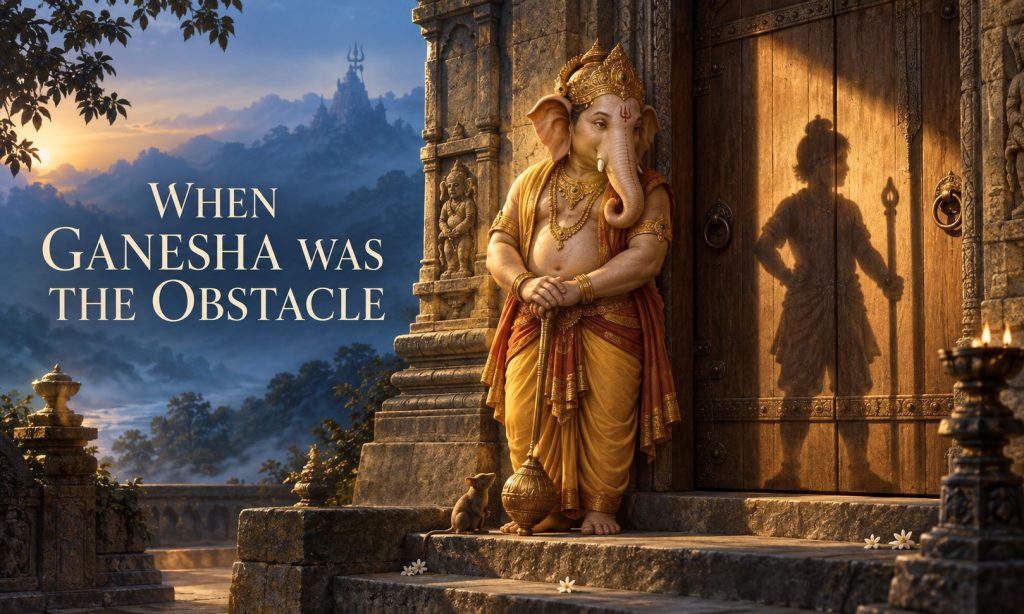
Before asking Vighnesa to clear our path perhaps we should understand why something is standing there
సున్ని పిండిని నలిచి చిన్నారిగా మలిచి..
సంతసాన మునిగింది సంతు లేని పార్వతి
సుతుడన్న మతి మరచి.. శూలాన మెడ విరిచి
పెద్దరికము చూపే చిచ్చుకంటి పెనిమిటి
Translation
From the fragrant paste upon her skin, Parvati shaped a little child ;
and the mother who had long remained childless, lost herself in the happiness of having a son.
But the fiery-eyed lord, not knowing the child before him, raised his trident and ended that young life ;
authority announcing itself , before understanding had entered the doorway.
In four earthy lines in telugu for a song written by Seetaramasastry garu for the movie Swathi Kiranam, a cosmic story becomes a household tragedy. Goddess Parvati shapes a child with her own hands and discovers the happiness of motherhood. The child receives his first responsibility. A father returns and finds an unfamiliar guard at his own door. Within moments, affection, authority, obedience and violence collide at a threshold.
We remember what happened next: the severed head, Parvati’s grief and fury, the elephant’s head, the restoration of life, and the promise that Ganesha would be invoked before every beginning. Yet I wonder whether we have remembered the events more carefully than the question hidden inside them.
Was Ganesha the obstacle, or was the real obstacle the failure to understand why he stood there?
The guardian at the door
In the best known Puranic account, Parvati creates the boy and asks him to guard the entrance while she bathes. Her instruction is clear, no one is to pass. When Lord Shiva arrives, the child refuses him entry. Ganesha does not stand there out of anger, ambition or defiance. His mother has entrusted him with a responsibility, and he treats that responsibility as absolute.
Parvati sees a guardian. Ganesha sees a duty. Shiva sees an obstruction. Each acts from what appears true from where they stand. None, at that moment, possesses the whole truth. Many of our deepest conflicts are not contests between truth and falsehood.
This is what makes the episode more than a tale about divine anger and miraculous restoration. They are collisions between partial truths. Shiva’s right to enter is real. Ganesha’s duty to prevent entry is real. Parvati’s boundary is real. Disaster follows because these truths have not yet been brought into relationship.
An obstacle is therefore not necessarily negative. It may be a boundary, a warning, a correction, a period of preparation or an invitation to notice what urgency has concealed. Understanding does not always make the obstacle disappear. Sometimes it removes the conflict surrounding it. Sometimes it reveals a way across. Sometimes it tells us to choose another road.
Harmony does not arise when one side defeats the obstacle. It arises when each partial truth finds its place within the whole.
When power meets a boundary
Ganesha’s first evident virtue in this story is not cleverness. It is integrity. He has no personal quarrel with Shiva. He expects no reward for refusing him. He remains at the door because he accepted a duty.
The refusal also exposes a difficult question. What happens when legitimate authority encounters a legitimate boundary? Power often assumes that resistance is disrespect. A rule appears unnecessary to the person inconvenienced by it. A guardian appears arrogant to someone accustomed to immediate access. A pause appears wasteful to someone certain of his destination.
The rustic force of the song’s phrase peddarikamu chupe chichukanti penimiti lies here. It brings the divine conflict into familiar human language: the fiery-eyed husband displays his seniority before he understands the person confronting him. We need not place Shiva on trial. Puranic stories frequently use extreme action to expose truths that polite situations leave hidden. Here the truth is uncomfortable. Great power is not the same as complete knowledge.
The episode also resists an easy celebration of blind obedience. Ganesha is faithful, but he has incomplete information. Shiva possesses authority, but he too has incomplete information. Parvati alone can explain the relationship between the child, the instruction and the threshold. Until that larger context arrives, everyone acts inside a smaller world.
This may be our first glimpse of Ganesha-tattva: firmness must be joined by discernment, and authority must be joined by the humility to ask why a boundary exists.
The obstacle beneath the obstacle
Ganesha is the visible obstacle at the door. Beneath him, however, lie several invisible obstacles: assumptions, missing information, instructions without exceptions, offended authority, urgency and the failure to pause. The body at the threshold is only the point at which these failures become visible.
We continue to make the same mistake. We identify the person delaying a proposal as the obstacle. We identify the rule preventing immediate action as the obstacle. We identify a rejected application, an unanswered message, a financial constraint or a reluctant family member as the obstacle. We then direct all our energy towards removal.
But the visible obstruction may be carrying information. The proposal may be incomplete. The rule may preserve a lesson paid for by an earlier failure. The silence may be a boundary. The delay may expose a gap in our preparation. Resistance may tell us that the beginning we desire is premature, poorly understood or simply wrong.
This does not mean that every obstacle is wise or benevolent. Some are produced by injustice, incompetence, prejudice or chance. Those must be confronted. Ganesha-tattva does not ask us to submit passively to every obstruction. It asks us to diagnose before we destroy. We must know whether the obstacle should be removed, respected, negotiated with, learned from or recognised as something within ourselves.
Do not first ask how to remove the obstacle. Ask what the obstacle is doing there.
A restoration that remembers the wound
When Parvati reveals the truth, the conflict changes. Her grief and fury force every partial account into the same frame. Ganesha is restored with an elephant’s head, but he is not returned to his earlier form.
That detail deserves more attention than it usually receives. Repair does not erase what happened. Life returns, relationship is restored and a new future becomes possible, yet transformation remains visible. The familiar face of Ganesha carries the memory of a misunderstood duty and an irreversible act.
We often imagine reconciliation as a return to the moment before injury. Real restoration seldom works that way. An apology cannot make an event unhappen. Forgiveness may end hostility, but it does not always restore the face we had before the conflict. Healing sometimes means becoming capable of carrying what cannot be undone.
Shiva’s response does not end with revival. The guardian of one doorway is recognised as the leader of the ganas and is given precedence at beginnings. His original quality, steadfast responsibility, is not discarded. It is enlarged by a wider identity. The child who defended one threshold becomes the intelligence invoked at every threshold.
The seer among seers
गणानां त्वा गणपतिं हवामहे
कविं कवीनामुपमश्रवस्तमम् ।
ज्येष्ठराजं ब्रह्मणां ब्रह्मणस्पत
आ नः शृण्वन्नूतिभिः सीद सादनम् ॥
Long before the Puranic doorway entered popular imagination, the Rigveda used the title Ganapati in a celebrated invocation. In its original setting, Rigveda 2.23.1 addresses Brahmanaspati. It does not unambiguously describe the elephant-headed son of Shiva and Parvati. Later Ganesha worship adopted the verse so completely that it is now among his most familiar invocations.
That distinction need not weaken devotion. It offers a more interesting question. What did later tradition hear in these words that made them belong so naturally to Ganesha?
Gana can signify a group, multitude, class or organised body. Human life arrives as many things at once: thoughts, duties, desires, relationships, warnings, opportunities and competing truths. Pati is the leader or governing principle. Ganapati can therefore be contemplated as the intelligence that prevents multiplicity from collapsing into disorder.
The verse calls the invoked presence kavim kavinam. Kavi in this early setting carries more than the modern meaning of poet. It suggests a seer, one who perceives patterns and consequences. The world now possesses extraordinary powers of calculation and prediction, yet foresight remains scarce. We can produce an answer before deciding whether the question deserves to govern our action.
The invocation also asks the lord of potent speech to hear and take his seat. The association matters. The intelligence connected with speech is first approached as one who listens. Leadership begins before the command, in the attempt to understand the many voices that must be brought into order.
Seen through the doorway episode, the later adoption of the verse becomes meaningful. The young guardian has integrity but only a partial view. The restored Ganapati is imagined as the seer among seers, the organiser of the many and the listener who understands before acting.
What faded from the familiar prayer
The Puranic story did not replace philosophy with superstition. It made difficult ideas memorable. A proposition about authority, incomplete knowledge and boundaries might remain among scholars. A story about a child guarding his mother’s door can travel through homes, temples, songs, performances and generations.
Every retelling, however, places its light differently. Sanskrit theology may emphasise cosmic identity. Temple practice emphasises presence and worship. Folk language brings divine relationships into the household. Children’s stories emphasise obedience and parental love. Festival culture emphasises auspiciousness, celebration and collective belonging.
No one layer is necessarily false. The loss occurs when a many layered tradition is compressed into a convenient promise: pray to Ganesha and the problem will go away.
Vighnesha means lord or governor of obstacles. The name need not imply an obligation to remove whatever stands between us and our wishes. A governor of obstacles may remove one, place another, reveal a third and allow a fourth to remain until we are ready to understand it.
Perhaps this is what has faded from ordinary invocation. We seek relief from friction but overlook discernment. We ask for successful beginnings without asking whether the undertaking deserves to begin. We request an open road before examining our direction.
Truth that belongs to a larger order
The later Ganapati Atharvashirsha offers another way into Ganesha-tattva. It declares tvameva pratyaksham tattvam asi: you are the directly perceptible principle or reality. The visible form is therefore an entrance, not an endpoint. The elephant head is visible; the intelligence it asks us to cultivate is the tattva. The mouse is visible; the restless appetite that must be governed is the tattva. The obstacle is visible; the judgment needed to interpret it is the tattva.
The same text includes the declaration ritam vacmi satyam vacmi, commonly rendered as I speak what accords with order, I speak the truth. Satya asks whether a statement is true. Rta asks whether it belongs to a truthful and sustaining order.
The distinction is painfully current. A statistic may be accurate and still be used to mislead when context is removed. A video may contain real images arranged to create a false conclusion. An artificial intelligence system may generate fluent sentences without bearing responsibility for the action they inspire. Factual fragments do not automatically create truthful understanding.
Ganapati as guardian of meaningful speech asks more of us. Are the words accurate? Have we listened? Do they clarify the whole or weaponise one fragment of it? Do they help the many find order, or merely give our partial truth a louder voice?
Vighnesha in an impatient world
We are building a world designed to eliminate friction. Applications promise one click decisions. Algorithms remove pauses. Artificial intelligence shortens the distance between intention and execution. Convenience has genuine value, but friction is not always a design failure.
A second approval may prevent a dangerous payment. A warning may stop the disclosure of sensitive information. A dissenting colleague may identify the weakness everyone else has learned to ignore. A waiting period may prevent an irreversible decision made in anger. A locked door may protect the person on the other side.
The lesson is not that delay is holy. It is that speed cannot determine which delay is meaningless. That requires judgment.
This is where Ganesha remains relevant to a generation surrounded by information but short of attention. His intelligence is not the ability to produce endless answers. It is the ability to organise the many. His wisdom is not the guarantee that every undertaking will succeed. It is the foresight to question a beginning. His mastery of obstacles is not a promise of effortless movement. It is the capacity to understand resistance without immediately becoming its enemy.
A rejected proposal may be asking for better preparation. A troubled relationship may be revealing a boundary we refuse to acknowledge. A stalled ambition may expose that the dream belongs to an earlier version of ourselves. A rule may be obsolete and deserve removal; another may contain institutional memory that no one has bothered to explain. The obstacle becomes useful only when we learn how to read it.
Why Ganesha is standing there
Sunni pindini nalichi chinnariga malichi. Parvati gives the child form from what lies within her reach. The story then shapes him through responsibility, conflict, loss, restoration and recognition. He who first stands as an obstacle becomes Vighnesha, lord of obstacles.
Perhaps that transformation contains the teaching we have made too convenient. Ganesha does not stand before every beginning merely to make the road effortless. He asks whether we have understood the road at all.
Before demanding that resistance disappear, have we listened to what it is saying? Before overruling the person at the threshold, do we know whose boundary is being protected? Before treating delay as failure, have we examined our readiness? Before invoking success, have we asked whether the beginning is aligned with truth?
Ganesha may not be telling us that every obstacle should disappear. He may be asking whether we possess the intelligence to understand why it is there, the discipline to prepare for it, and the humility to recognise when it is protecting us from a wrong beginning.
We have invoked Ganesha before every beginning. It may be time to understand what we have been invoking.