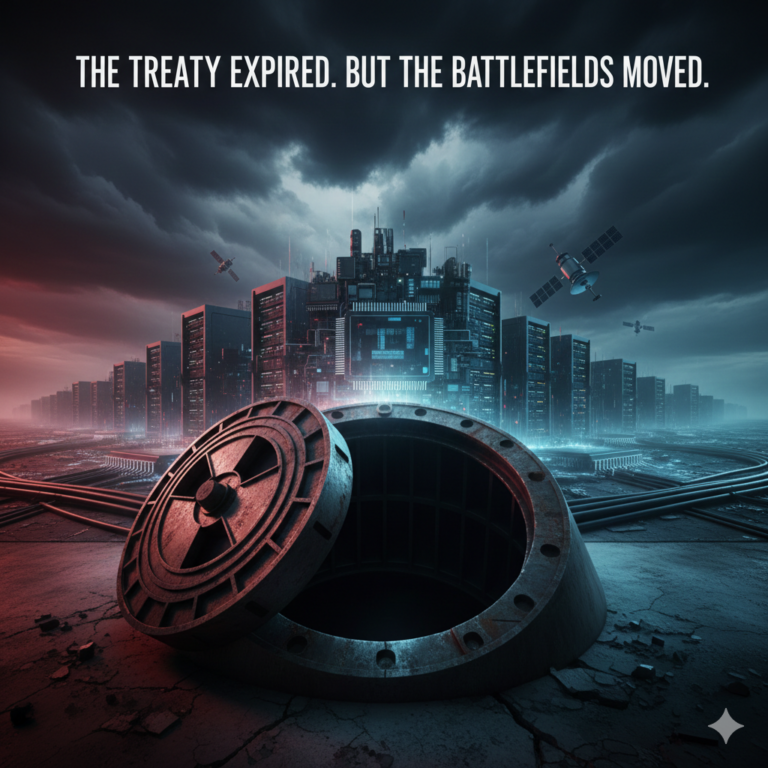
The expiry of New START marks the end of an orderly era of nuclear accounting. The new anarchy is digital, industrial, and far harder to count.
When the “New START” treaty was signed in Prague in 2010, it arrived as the final, polished gear of a Cold War machine that still, remarkably, functioned. The United States and Russia the weary custodians of 90% of the world’s nuclear inventory agreed to a sensible cap of 1,550 deployed strategic warheads each. More importantly, they agreed to let each other peek under the hood. Verification was the soul of the deal; to trust was human, but to inspect was strategic.
That era has now ended. With the expiration of the treaty, the last binding cord between Washington and Moscow has snapped. To the catastrophists, this is a “Big Bang” moment a return to the unbridled arms races of the 1960s. Yet a more unsettling interpretation is available: New START did not expire because the world became obsessed with nuclear war, but because the world’s most intense battles have migrated from the silo to the semiconductor.
A relic from a different planet
In retrospect, the world of 2010 looks quaintly orderly. Globalisation was viewed as an unstoppable tide rather than a series of traps. Supply chains were mere economic plumbing, not strategic garrotes. Cyber-attacks were a nuisance for IT departments, not a decisive opening gambit for an invasion. Russia, though surly, was a power whose ambitions were thought to be constrained by a post-Soviet hangover and a hollowed-out military.
In that world, nuclear warheads were the primary currency of power. Today, that currency has been devalued by a basket of newer, more versatile assets. The Russia of 2026 is no longer interested in the performative restraint of the Obama-Medvedev years. Having modernised its triad and invested in “exotic” delivery systems—hypersonic gliders and nuclear-powered torpedoes designed to make American missile defences look like expensive lawn ornaments Moscow has found that it can endure staggering economic pain to redraw maps. Restraint, in the Kremlin’s current lexicon, is a synonym for weakness.
The Tri-polar Trap
Compounding the collapse of the Russo-American duo is the emergence of a third player that refuses to sit at the table. China’s rapid nuclear breakout building silos in the desert at a pace that suggests a peer level ambition has rendered the old bilateral logic of New START obsolete. Washington is loath to sign a deal that ties one hand behind its back while Beijing remains unconstrained.
This “tri-polar” dynamic creates a mathematical headache for arms controllers. In a two-player game, stability is a matter of simple mirroring. In a three-player game, every move by one party risks a doublereaction from the others. The result is a paralysis of diplomacy. While the US and Russia stare each other down over the carcass of New START, China’s “quiet” rise ensures that any future treaty would require a geometry far more complex than anything imagined in 2010.
The Fog of Peace
It is tempting to view the treaty’s demise as a cliff edge. In truth, it is more like wandering into a thicket. The immediate danger is not that 1,550 warheads suddenly become 1,750 an increase that does nothing to change the grim mathematics of Mutually Assured Destruction. As Winston Churchill once noted of nuclear parity, it only serves to “make the rubble bounce.”
The real peril is the collapse of predictability. New START provided the “rules of the road” inspections, notifications, and data exchanges that prevented a glitch on a radar screen from turning into an existential misunderstanding. Without it, both sides are operating in a strategic fog. And fog is where miscalculation thrives. When you can no longer count your opponent’s missiles, you are forced to assume they have the maximum possible number. This “worst-case” planning is the engine of accidental escalation.
The new battlefields
While the nuclear “ceiling” remains in place, the contest beneath it has expanded into every artery of modern life. We have entered the era of the “Grey Zone,” where conflict is constant but stays just below the threshold of open war. The most consequential struggles of 2026 are fought through systems:
- Compute as Command: The ability to design and restrict high – end semiconductors is the new high ground. A nation without chips is a nation without a modern military. AI driven targeting and autonomous swarms have made silicon as vital as steel was in 1942.
- The Subsea and the Stratospheric: Cutting an undersea cable or jamming a satellite is the ultimate “grey zone” act devastating to a modern economy, yet possessed of a plausible deniability that a missile strike lacks.
- Biological Brittle-points: As the world learned in 2020, a pathogen can paralyse a superpower faster than an army. Bio-security is no longer a health concern; it is a core pillar of national defence.
The White Elephant in the room
Nuclear weapons are increasingly becoming “white elephants”: ruinously expensive, politically heavy, and strategically awkward. They are the ultimate backstop, yet they are nearly impossible to use in the granular, high-speed skirmishes of the 21st century. How do you deter a state-sponsored cyber-heist or a supply-chain blockade with an ICBM? You cannot. To use a nuclear weapon against a non-nuclear provocation is a recipe for global pariah status; to threaten its use is often seen as a bluff.
Even India, a nuclear power with a traditionally stoic strategic culture, seems to have intuited this. New Delhi rarely indulges in the theatrical nuclear chest-thumping common in the West. Instead, its “war rooms” are focused on maritime trade routes, indigenous chip fabrication, and critical mineral alliances in Africa and Australia. For India, security is found in resilience, not just in megatons. It understands that in a world of “everything-as-a-weapon,” the most robust deterrent is a self-sufficient supply chain.
The bottom line
The death of New START is a tragedy of transparency. It leaves the world’s two largest nuclear arsenals unmonitored for the first time in decades. But the bigger story is that the 20th century’s frameworks are collapsing because they no longer describe the way we fight. Modern instability is driven by speed and ambiguity. Hypersonic missiles compress decision times from thirty minutes to six; AI-generated deepfakes can spark a crisis before a diplomat can pick up the phone.
The bomb hasn’t gone away; it has simply been crowded out by a thousand smaller, sharper blades. The task for the next generation of statesmen is not just to count warheads, but to build guardrails for a world where the most dangerous weapon might be a line of code or a closed shipping lane.