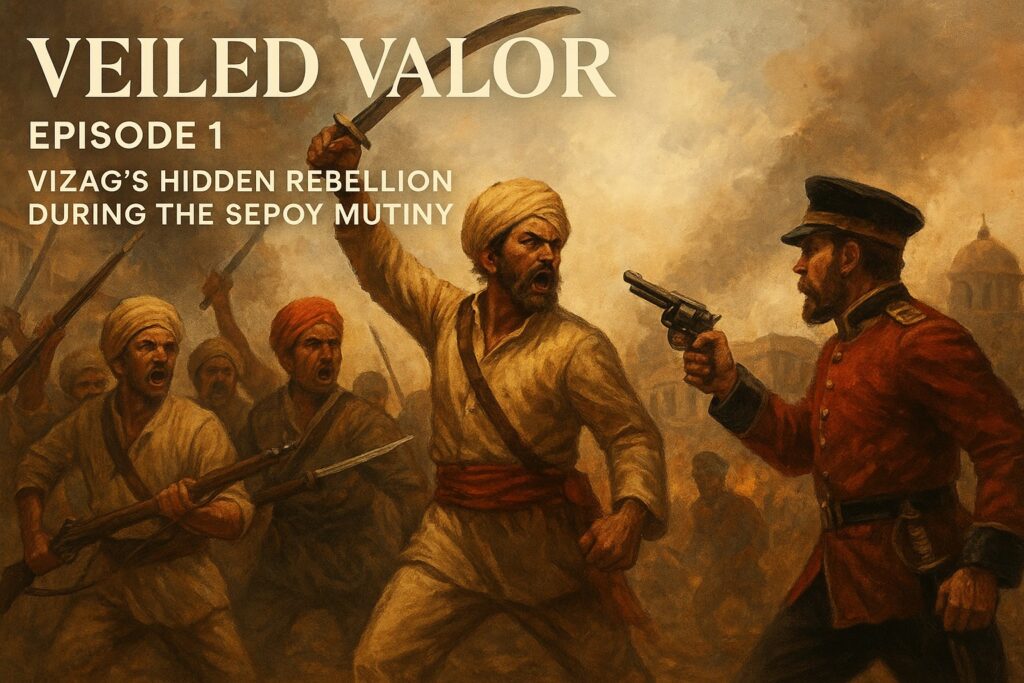
Vizag’s Forgotten Sepoy Mutiny of 1780
There are days in life that feel ordinary on the surface, until a single moment shifts your entire understanding of the place you call home. One such day began with a sea breeze on my face and ended with a buried truth in my heart. I was walking through Old Town, Vizag, as part of a heritage trail led by Jayshree Hattangadi, a historian and storyteller who has spent years unearthing the forgotten past of this city. Her walks are not just strolls through crumbling buildings or silent cemeteries. They are conversations with memory layered with whispers, architecture, politics, and poetry.
That morning, she stopped beside a time worn grave inside the Old Town Cemetery and gently pointed to the inscription on a fading tombstone:
“Cadet Kingsford Venner — Killed in a
mutiny, 1780.”
Puzzled,
I asked her Mutiny? In 1780?
“Is
this a typo?” I asked. “You mean 1857, right?”
Jayshree
garu shook her head slowly.
“No, Govind. This was long before that.”
That single gravestone, I would soon learn, marks one of India’s earliest recorded acts of military rebellion against the East India Company. And it happened right here in my own city. The old Vizagapatam district gazetteer records a “serious mutiny” among sepoys on 3 October 1780, and the
same cemetery record identifies Venner as a 19-year-old cadet killed in that uprising.
What We Were Never Taught
As someone fascinated by geopolitics and history, I could not believe that such a crucial episode had barely entered our textbooks, speeches, or school assemblies. We all grew up hearing about 1857 the Great Revolt, the First War of Independence. We read of Mangal Pandey, the sepoys in Meerut, and the siege of Delhi. But Vizag’s uprising of 1780, predating Meerut by nearly eight decades, rarely made it even into the footnotes.
That silence needed correcting.
So, I began tracing the faint footprints of this rebellion through district gazetteers, British era references, local history writing, news reports, heritage conversations, and the memories preserved by Vizag’s own chroniclers.
What I found was not merely a “minor mutiny.” It was a story of defiance, strategy,
betrayal, sacrifice, and deliberate forgetting. A story worth remembering not just for Vizagites, but for every Indian who believes the freedom struggle began only in 1857. Because in truth, the fire was lit far earlier.
Vizagapatam in 1780: A Small Town in a Big War
To understand what happened that afternoon, we must first return to the world of 1780.
Vizagapatam was not yet the bustling city as we know today. It was a strategic but modest
coastal settlement of the East India Company, part of the Northern Circars, with a fort, a roadstead, a small European settlement, and native sepoys posted under British command. It was a place where empire looked both confident and insecure. Confident enough to command, insecure enough to fear the sea, the French, Hyder Ali, local zamindars, and its own sepoys.
Far to the south, Hyder Ali of Mysore was pressing the British hard in the Carnatic. The Company needed reinforcements. On 14 September 1780, the Governor of Madras, John Whitehall, instructed James Henry Casamajor, the Company’s chief at Vizag and Masulipatam, to prepare local troops for service against Hyder Ali. Later accounts note that the sepoys at Masulipatam complied, but those at Vizag did not.
This was the first hidden layer of the story: the Vizag rebellion was not born in isolation. It was tied to a larger South Indian war, to Mysore’s challenge to British power, and to the Company’s desperate attempt to move troops from the coast to the battlefield.
The second hidden layer was more personal. The sepoys were already a disgruntled force. They were reportedly unhappy over unpaid dues and commission for revenue related duties that they considered beyond normal military service. Many among them were Muslims, and some accounts suggest they were reluctant to fight Hyder Ali, whom they saw not merely as an enemy of the British but as a figure worthy
of admiration.
So when the order came, it was not simply a matter of boarding a ship. It was a matter of conscience, loyalty, dignity, and survival.
The Afternoon the Sepoys Said “No”
On 3 October 1780, around three in the afternoon, the sepoys of Vizag were expected to board the Sartine Frigue, a frigate waiting in the harbour along with other vessels. The gazetteer, quoting Hicky’s Bengal Gazette, records that the troops had their arms, accoutrements, baggage, and equipment ready for embarkation to Madras. But there is one detail that makes the scene unforgettable.
On the very day the troops were to embark, the Company’s local chief had invited the military officers to dine with him and the Council. The officers ate calmly, toasted British success, and sat, as the old account suggests, with complete confidence unaware that outside, the men they commanded were nearing the edge of rebellion.
Behind the official calm, the sepoy lines were turning restless. The order was clear: march to the beach, board the Sartine, sail south, and fight Hyder Ali.
The sepoys refused.
Their officers came out to restore command. The order was repeated. The refusal hardened.
Then the Grenadiers raised their muskets. In that instant, Vizag crossed from obedience into history.
The Fire Unleashed
The volley was sudden and devastating. The rebels killed Lieutenant Crisps, Cadet Kingsford
Venner, and Robert Rutherford, the paymaster. Other officers, including Charles Maxtone and a
frigate officer named Lane, were gravely wounded, though some managed to escape back towards the ship.
But the firing was only the beginning.
The sepoys seized control of the town. They captured James Henry Casamajor and other civil servants. They released a Frenchman who had been imprisoned on suspicion of being a spy an extraordinary detail that places this local mutiny inside the larger geopolitics of the age, when the French, Mysore, and the British were entangled in a contest for power in South India.
Then came the treasury.
The rebels looted Company property and seized cash reportedly amounting to Rs. 21,999 not a small sum in 1780. They also took arms and ammunition, transforming their rebellion from an emotional outburst into an armed movement with a destination.
For a brief moment, Vizagapatam was no longer under Company control. Imagine that for a moment. The
fort, the treasury, the officers, the prison, the arms all shaken in a single afternoon by men who were supposed to be the Company’s own instruments of power.
This was not merely indiscipline.
This was the empire being struck from within.
The Plan: To Join Hyder Ali
The mutineers did not intend to stay in Vizagapatam. Their plan was bolder. On the morning of 4 October, they marched out of town with Casamajor and other Company officials as captives, intending to join Hyder Ali’s forces. In strategic terms, this was the most dangerous part of the episode. Had they succeeded, the rebellion would not have remained a local mutiny. It could have become a link between rebellious sepoys in the Northern Circars and Mysore’s wider military challenge to British authority.
That is what makes this story so powerful.
The sepoys were not simply escaping punishment. They were trying to cross from mutiny into alliance.
From grievance into war. From Vizag into the larger anti-British theatre of South India. If history had turned slightly differently, this coastal spark might have fed a much larger fire.
The Fatal Mercy
Then came the mistake that changed everything. While marching south, the rebels released Casamajor and the other captives. Some accounts say this happened after persuasion by Gajapathi Narain Deo, a local zamindar. Perhaps it was mercy. Perhaps the rebels believed releasing civilian prisoners would win them goodwill or reduce pursuit.
But in rebellion, mercy can sometimes become a door left open for the enemy. Casamajor returned to the Sartine and the town. He moved quickly. He ordered Ensign Butler and loyal forces to regroup, armed them with help from the ship and surviving Company men, and appealed to neighbouring zamindars to
deny assistance to the mutineers. The released captive became the organiser of retaliation.
This is one of the most painful turns in the story.
A rebellion that had shaken the Company in Vizagapatam was now being hunted
through the countryside by the very authority it had briefly captured.
Gudderallyvanka: The Gorge Where the Trail Fades
On 8 October 1780, the rebels were reportedly surrounded and ambushed near a gorge at Gudderallywanka, close to present-day Payakaraopeta. Most were killed in the confrontation. Some accounts suggest that Shaik Mohammed and a small group escaped, only to be captured and executed months later. Other retellings compress the end into a harsher silence: some killed in the ambush, others
executed mercilessly by Company forces. This uncertainty itself is telling.
The British recorded the deaths of their own. They preserved the tomb of Venner. They noted the outrage against Company authority.
But the names of the Indian sepoys fade into the margins.
How many were killed?
Where exactly were they buried?
Did their families know?
Did any escape into anonymity?
History offers us fragments. The rest is silence.
And in that silence stands Subedar Shaik Mohammed Khan leader of the Grenadiers, organiser of the refusal, the man whose name should have been carved into public memory but was instead allowed
to drift into obscurity.
The British Were More Frightened Than They Admitted
One of the most revealing pieces of this story comes not from nationalist memory, but from British anxiety. Later accounts cite Casamajor’s own testimony, preserved in British records, acknowledging that the “revolt of the grenadiers” could have had dangerous consequences and had dealt a severe blow to the Company’s power and prestige. The incident is also said to have triggered changes in administration, fortification, and regulation.
That matters.
Colonial governments often minimized rebellions in public while taking them very seriously in private. Publicly, a revolt could be dismissed as a “disturbance.” Administratively, however, it could lead to reviews, punishments, fortifications, intelligence measures, and stricter controls. This is how empires preserve image: by reducing danger in language while responding to it in action. The British may have tried to shrink the Vizagapatam mutiny into a small military incident. But their own reaction suggests they understood its potential.
If sepoys in a coastal outpost could refuse orders, kill officers, loot the treasury, capture the chief, free a French prisoner, and attempt to join Hyder Ali, what else could happen?
What if Masulipatam had followed?
What if more sepoys had joined?
What if Hyder Ali had received them?
What if 1780 had found its Meerut?
Why 1857 Became Memory and 1780 Became a Footnote
This question troubled me the most.
Why did 1857 become national memory, while 1780 became a forgotten corner of a district gazetteer?
Part of the answer is scale. The 1857 revolt spread across large parts of North and Central India. It involved soldiers, peasants, rulers, civilians, cities, sieges, proclamations, massacres, reprisals, and a direct challenge to Company rule. It changed the structure of the British Empire in India. Vizag’s 1780 mutiny was smaller, shorter, and geographically contained.
But scale alone does not decide memory.
Memory is also shaped by who records, who teaches, who commemorates, and who builds monuments. The British had every reason to bury a story in which their own sepoys turned on them so early. Later nationalist histories, built around the great drama of 1857, had little space for a coastal rebellion that came before the vocabulary of nationalism itself had formed.
That is why Vizag’s story slipped between two categories. To the British, it was too dangerous to celebrate. To later nationalist memory, it was too early to fit the script. And so it survived in the most fragile way possible: in a grave inscription, a few gazetteer lines, local research, and the stubborn work of heritage keepers.
A City That Tried Too Early
There is something tragic and noble about being too early. Vizag tried to rebel before the rest of the country was ready. The men who rose up did so without slogans, without Congress committees, without national flags, without newspapers calling them freedom fighters. There was only injustice.
There was only the refusal to board. There was only the decision that a soldier’s obedience has a limit when dignity is stripped away. In a way, this makes the 1780 mutiny even more powerful. It was not born from a fully formed ideology of nationalism. It was born from the raw human instinct to resist exploitation and humiliation.
It was not yet India speaking as a nation. It was India clearing its throat.
Standing on a Legacy We Forgot
As I walked back from the cemetery that day, I looked at Old Town with new eyes. The port, the fort, the narrow lanes, the old European graves, the sea that carried ships of trade and war everything seemed altered. I had passed through these places before, but now they carried another layer. History
had been under my feet all along. Why isn’t there a statue of Subedar Shaik Mohammed Khan?
Why isn’t there a memorial at Old Town for the sepoys of 1780?
Why do we know the name of the British cadet whose grave survived, but not the names of the Indian soldiers who stood beside Shaik Mohammed?
Why are our children not taught that Vizag lit one of the earliest sparks of sepoy resistance?
In 2021, historians and heritage conservationists in Vizag again called for a memorial to recognize the 1780 mutiny in One Town, noting that Venner’s grave remains one of the few surviving physical testimonies to the event. That call should not fade. Because cities do not become great only by building flyovers, ports, malls, and glass towers. They become great by remembering correctly.
The Grave That Refused to Forget
The irony of this story is almost painful. The only prominent surviving marker of the mutiny is not a memorial to the Indian rebels, but the grave of a young British cadet. Yet perhaps history works in strange ways. That grave, meant to remember an officer of empire, has become evidence against the empire’s silence.
The word “mutiny” sits there like a scar.
A single word, carved in stone, asking us to reopen an entire chapter. That is what I felt on Jayshree garu’s walk. Not just curiosity. Not just surprise. A kind of responsibility. Because when a city forgets its rebels, it also forgets a part of its own courage. And when it remembers them, even late, it repairs something within itself.
Closing Reflection: The First Spark
There is a line I wrote that stays with me:
Freedom is not just won. It is remembered. And memory begins with telling the story again.
This is my way of doing that.
This blog is my platform, and Veiled Valor is my tribute not just to the sepoys who fired the first shots, but to every unsung soul who dared to imagine freedom before it had a national anthem, a party office, or a
flag. Subedar Shaik Mohammed Khan and his men did not win that October week in 1780.
But they did something history should never forget.
They said no.
They said it at the edge of the sea, under the shadow of a waiting frigate, before the empire had learned to fear the word “sepoy.”
And from that refusal came a spark.
Faint, brief, buried, but real.
A spark that Vizag must now carry back into the light.