When Fiction Became a Forecast
Two decades ago, The Da Vinci Code transformed a museum into mythology. The Louvre was depicted as a cathedral of secrets, a sanctuary where technology, intellect, and art coexisted in perfect equilibrium. Its security seemed absolute, its vigilance eternal. But fiction is often prophecy in disguise.
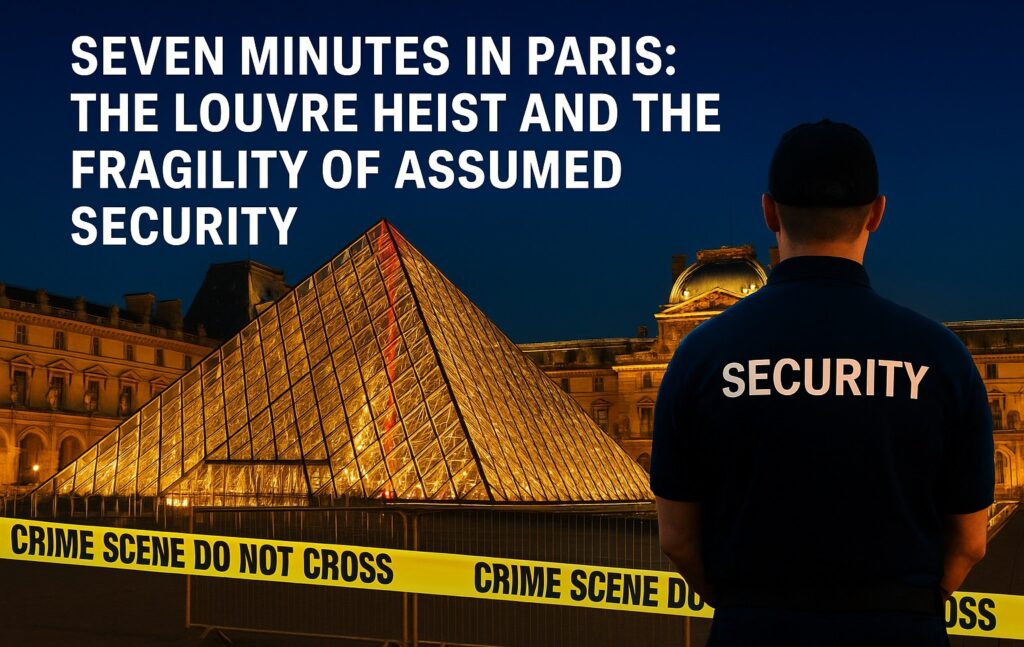
Now in 2025, that aura of invincibility shattered not under the weight of conspiracy, but of complacency. A small, disciplined crew breached layers of procedure, escaping with national treasures in under eight minutes. This was not just a heist; it was a metaphor. A mirror held up to every organization that confuses habit for preparedness and paperwork for protection. In security, the greatest vulnerability isn’t a flaw in the system; it’s the assumption that the system is flawless.
The Mirage of Control
The Da Vinci Code made security feel sacred. A fusion of intellect and machinery that left no room for human error. Reality told a harsher story. The breach was clinical, precise, and quietly devastating.
Key Lapses
- Fragmented escalation logic: No unified threshold for moving from “alert” to “lockdown.”
- Tool disparity: Analog radios and digital comms operated in silos.
- Human-dependent activation: Automation gaps turned seconds into vulnerabilities.
It was a failure not of vigilance, but of imagination.
Systems triggered, but minds hesitated. Communication froze, not from fear, but from confusion over authority. The fortress failed not at the level of sensors or locks, but at the interface of human decision and technological design.
“If you know the enemy and know yourself, you need not fear the result of a hundred battles.”
— Sun Tzu, The Art of War
In this case, the institution knew its tools but not its weaknesses. A dangerous imbalance.
The Comfort of Ritual
Preparedness often masquerades as perfection. In most institutions, drills become rituals….predictable, rehearsed, and comfortable. The exercises that should simulate stress instead confirm routine. Fire evacuations are mastered; armed intrusions are imagined. Everyone plays their role and nothing is truly learned.
Repetition is the slowest form of decay and Predictability breeds the illusion of mastery. The lesson is quiet but clear: we do not need new doctrines. We need to rediscover the discipline of testing the ones we already wrote. Incident playbooks, mock drills, and access controls must be treated as living organisms. Measured, challenged, and evolved. Because security, much like art, loses meaning when it becomes mere decoration.
The Human Variable
Herre investigations pointed to insider familiarity, floor plans, patrol routes, predictable access times. Yet the core issue wasn’t betrayal; it was boredom. When vigilance becomes monotonous, attention dulls.
Repetition desensitizes. The familiar becomes invisible.
In a world where threats mutate faster than policies, the human element remains the softest target. Behavioural analytics, task rotation, and stress testing aren’t luxuries. They are oxygen for operational resilience.
Leadership must design unpredictability into the system. Rotate personnel, diversify duties, and empower analysis that detects early anomalies in speech, keystrokes, or movement. Security is not sustained by suspicion but by awareness engineered against monotony.
Disguise, Deception, and the Death of Trust
The intruders walked in dressed as maintenance staff, echoing cyber intrusions, where attackers mimic legitimate users. They didn’t need to bypass the system; they simply blended into it.
The principle of Zero Trust, long preached in cybersecurity, must now take its rightful place in the physical world. Every identity, device, and credential must be verified continuously. Not just once at entry, but at every step of movement. In security, legacy trust is liability.
The future demands context driven authentication, access granted based on time, role, purpose, and behaviour. Because in both cyberspace and the real world, authenticity without revalidation is an invitation to breach.
Beyond Paris: Lessons for Critical Infrastructure
From the harbours of Vizag, this pattern feels unnervingly close. Here, art is replaced by cargo, and galleries by terminals, but the anatomy of vulnerability is identical. The same complacency that delayed a lockdown in Paris could stall a response to a maritime cyber incident, a data breach in SOC, or an insider compromise at an energy grid. Our adversaries no longer cross borders; they cross systems. They exploit trust, timing, and fatigue. The same trinity that enabled the heist.
Geopolitical Insight:
In the era of hybrid warfare, the battlefield stretches from pipelines to pixels. Adversaries (State or non-state) exploit seams between the physical, human, and cyber domains.
Strategic control is no longer about territory; it is about tempo. Whoever adapts faster controls the outcome. From docks to data centers, from museums to Mega Industries, the challenge remains the same. Resilience is not built on walls, but on awareness.
Rediscovering Discipline
We must treat every audit, drill, and playbook as a living system, one that breathes, changes, and questions itself. Preparedness must evolve from compliance to culture.
Security failed not in technology, but in the assumption that technology was enough.
Automation alone cannot save an inattentive institution. Machines extend reach; they do not replace reflection.
Complacency grows in repetition and Discipline thrives in renewal.
Resilient institutions treat discomfort as rehearsal, not disruption. They prepare their teams to foresee the unpredictable and convert every controlled failure into intelligence.
The Art Beneath the Armor
What unfolded in those seven minutes was more than a theft; it was a reminder that systems age faster than intentions. It showed that strength is not the opposite of fragility—it is its companion, waiting to be tested.
True resilience, like true art, is never complete. It demands continual interpretation, not as a monument to what was built, but as a rehearsal for what must endure.
From the halls of history to the harbors of today, one truth resonates: in a world where the velocity of threats outpaces the speed of response, survival belongs not to the most fortified, but to the most adaptive.
“The supreme art of war is to subdue the enemy without fighting.” — Sun Tzu
In our era, that art is no longer about conflict; it is about anticipation—seeing the unseen, questioning the comfortable, and designing systems that evolve before they are tested. Security, in its truest form, is not an end state but a continuous dialogue between awareness and adaptation. And perhaps that is the quietest lesson of all: we do not guard what we have—we guard what we are becoming.
As I was working on this piece, I came across a message shared by Mr. Singh, my mentor in the industry, and I truly resonate with what it intends to communicate. His visual note distills the essence of everything discussed here. Even the most secure institutions can fail quietly when routines replace reflection. The reminder to “review your defences before someone else tests them” is not merely operational advice; it’s a leadership principle. Every organization has its own crown jewels, data, people, reputation and each is guarded only as well as its willingness to question its own assumptions.
That message, simple yet profound, circles back to the very spirit of this post: resilience is not a static state but a conscious, continuous act of rehearsal. As the infographic says, even the Louvre thought it was just another Monday and that’s precisely when vulnerability chose its moment.