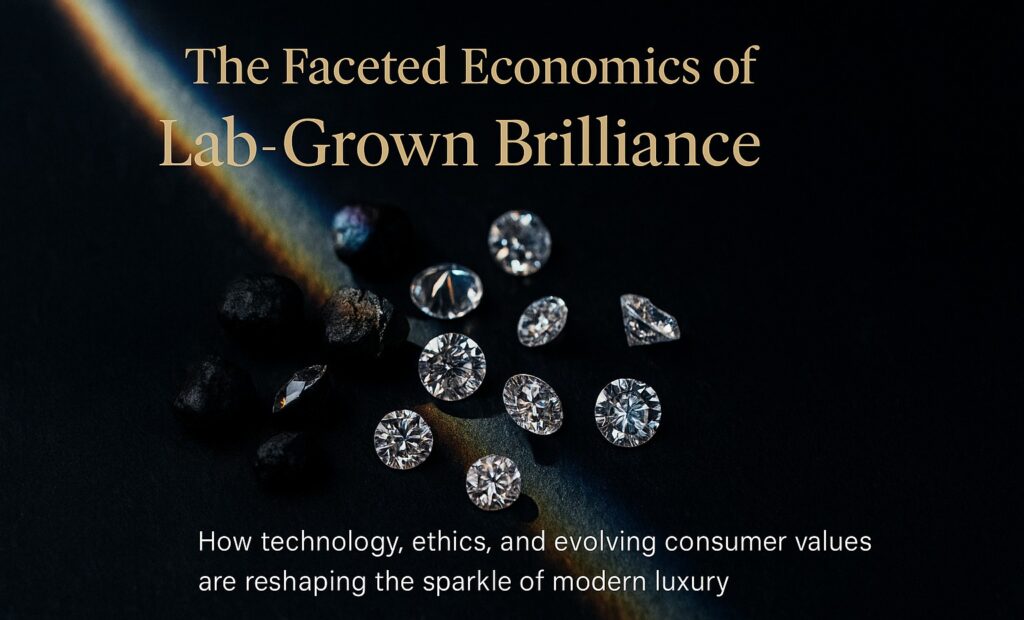
Lab-Grown Diamonds have reshaped how we think about brilliance. A few days ago, a friend sent me a message on WhatsApp a small post announcing that he is selling lab-grown diamonds. That caught my attention and started thinking how the whole landscape changed from those times I worked in worldwide diamond. Even Ten years ago, this would have sounded like science fiction. Today, it’s simply the new reality of luxury.
I couldn’t help recalling the words of, Mr. Luc J. Cleas, who during those opening sessions of training programs said, “Diamonds are for everyone.” When he said it almost three decades ago, he meant efficiency better yields, leaner operations, and affordable stones for more people. But standing in today’s world, those words carry a different resonance. Diamonds truly are for everyone now. Not just because they are accessible, but because technology and shifting values have redrawn the very idea of brilliance.
From Bourses to Open Markets
Fifteen years ago, the diamond trade shimmered behind closed doors. Antwerp’s bourses, London’s sight-holder systems, and Johannesburg’s tenders defined value through control. Prices were whispered; rarity was the story.
That world has transformed. Digital retail, labgrown innovation, and geopolitical realignments have moved the industry’s gravity eastward and online.
Antwerp remains symbolic today a name that still evokes the legacy of old-world diamond trade. A friend of mine, Cloves, who lives there, once told me during a conversation a couple of years ago, “Antwerp is now more symbolic than central when it comes to diamonds.” He was right. The rise of Surat’s scale and Israel’s precision has quietly redrawn the global map of brilliance. (The story of Antwerp’s own transformation through technology, especially around its port, is a fascinating chapter for another day.) but Surat and Mumbai hum with data-driven craftsmanship.
Moreover Younger buyers, especially Gen Z, are reshaping demand. They don’t just seek sparkle they seek story, ethics, and purpose. The narrative has shifted from secrecy to transparency.
De Beers: Reinvention in the Eye of Disruption
No brand has embodied the diamond industry’s evolution as starkly as De Beers. For nearly a century, it shaped the world’s perception of diamonds controlling supply, setting market norms, and embedding itself in popular imagination with the slogan “A diamond is forever.”
Yet as the market shifted, De Beers found itself at a crossroads. The surge of lab-grown diamonds, intensifying scrutiny over sustainability, and volatile pricing dynamics forced the titan to rethink its position. In 2018, it launched Lightbox Jewelry, offering lab-grown stones positioned more as fashion-forward statements than replicas of mined gems. It also championed Tracr™, a blockchain-based traceability platform that let buyers track a diamond’s journey turning authenticity into a digital signature.
But this year(May 2025), a dramatic shift occurred. De Beers announced it would shut down Lightbox, citing collapsing wholesale prices (a drop of nearly 90 % over the years) and a need to concentrate resources on its Origins Strategy a renewed focus on natural diamonds and high-return initiatives.
This move doesn’t signify retreat it signals refinement. By winding down its consumer LGD arm, De Beers aims to refocus on what it still does best: branding and marketing natural gemstones. Meanwhile, it maintains its industrial synthetic arm (Element Six) and continues to invest in traceability and narrative reinvention.
In other words, De Beers is no longer trying to dominate both mined and lab-grown sectors. It’s repositioning itself letting the market diversify while preserving its legacy in luxury and storytelling.
ESG Angle, Ethical Sourcing: The New Currency of Trust
Today’s consumer doesn’t just buy a diamond they invest in peace of conscience. Nearly one-third of fine-jewelry purchases in Western markets are influenced by ESG factors. Transparency is now strategy. Retailers log every touchpoint from mine or lab to market as a story of accountability. The paradox, however, remains: labgrown diamonds consume nearly 250 kWh per carat, often powered by coal grids. True sustainability, therefore, isn’t about choosing one over the other it’s about demanding clarity from both. Ethics has become the new premium cut.
Technology and the Art of Light
Among all transformations, none excites me more than the evolution of the Tolkovsky cut my lifelong fascination. When Marcel Tolkovsky in 1919, calculated the precise geometry for maximum brilliance: 58 facets, each tuned for perfect light return. His formula shaped a century of craftsmanship. Today, technology has refined his vision. Laser mapping, optical modeling, and AI-driven polishing arms can adjust angles dynamically, reading real-time light behavior. What Tolkovsky imagined with geometry, modern craft perfects with algorithms. We once relied on instinct and loupe; now brilliance itself is data-driven. Yet, the poetry remains the same brilliance is still about understanding how light behaves inside a human idea of beauty.
The Lab-Grown Renaissance
If technology redefined cutting, it revolutionized creation. Lab-grown diamonds (LGDs) once reserved for industrial drills are now centerpieces of engagement rings and ethical luxury. By 2024, LGDs made up roughly 25 percent of global diamond sales by value. Their prices, once only 20 percent below naturals, now stand at nearly 80 percent less. That affordability, coupled with ESG appeal, has opened new markets among young and design-conscious buyers.
This isn’t the death of natural diamonds it’s the rise of duality. Lab-growns define access; naturals define legacy. Together, they reflect a market where meaning matters as much as material.
India’s Festive Pulse and the Gold Connection
In India, the story sparkles differently. Gold has long been the language of celebration and security, yet rising prices and global trends have opened the door for diamonds especially during Diwali and the wedding season.
Today’s buyers view diamonds as versatile: symbols of love, status, and sustainability. Lab-growns in particular are driving a new aspiration ethical modern luxury that blends global values with Indian tradition. India, once the polishing powerhouse, is emerging as both producer and consumer proof that brilliance can be local and global at once.
Behind every facet of this transformation lies a quiet economic revolution. The contrast between mined and lab grown diamonds is as striking as their optical similarity. The average cost of producing a one carat lab grown diamond has plummeted from nearly $4,000 in 2016 to under $300 today, while the cost of extracting a natural diamond still averages between $1,000 – $1,400 per carat before it is even cut and certified. This cost compression has redrawn profit margins and pricing psychology alike. What was once an extractive, supply controlled trade has become a demand driven market. In classical terms, the industry is shifting from a “rent economy” built on rarity to a “competitive economy” built on efficiency and ethics. The winners in this new equilibrium will not be those who mine harder, but those who brand smarter turning transparency and traceability into the new margins of luxury.
Geopolitics of Brilliance
The diamond story is inseparable from global politics. U.S. and G7 sanctions on Russian diamonds notably from Alrosa, which contributes about 30 percent of world output have redrawn supply routes.
Botswana and Angola are reclaiming value through local beneficiation, while Dubai has emerged as a trading nexus between continents. Even Antwerp has changed, enforcing strict cash-transaction limits and compliance standards. Transparency is no longer a virtue it’s survival.
The Digital Revolution of Trust
The pandemic accelerated a shift. Between 2019 and 2025, online fine-jewellery sales grew 9–12 percent annually. Virtual showrooms, AR fittings, and blockchain verification have made it possible to buy brilliance with a click and trust it. The handshake has evolved into a digital ledger, but the sentiment remains timeless: trust, verified.
What the Stone Still Teaches
After two decades of watching this industry evolve, I’ve come to see diamonds as mirrors of civilization – enduring and ever-changing. Recently while watching an episode of Shark Tank, A founder was pitching their diamond jewelry line, and their entire focus wasn’t on the stone, but on design as their unique niche. It was a powerful reminder of how the narrative has shifted. From Antwerp’s vaults to Indian cutting hubs, from De Beers’ monopoly to blockchain marketplaces, every transformation tells the same story: to catch light differently, you must change your angles. The art of brilliance was never just about a stone’s hardness; it has always been about perspective. Today, that perspective is shifting from the intrinsic value of the material to the imaginative value of design the willingness to be refined, again and again, until light finds a completely new way through.
For the consumer, this economic shift translates into a compelling, albeit complex, value proposition. The most immediate benefit is accessibility. A larger, higher-quality lab-grown diamond is now attainable for a fraction of the cost of its natural counterpart, democratizing what was once a symbol of exclusive wealth.
Beyond the price tag, a new generation of buyers finds value in the narrative of innovation and ethics. Lab-grown diamonds offer a clear chain of custody, free from the historical conflicts associated with mined diamonds, which appeals to a conscience-driven consumer. However, the proposition is not without its trade-offs. While a natural diamond is often purchased with the expectation of retaining, or even appreciating, in value, a lab-grown diamond is more akin to a luxury consumer good. Its value is in the immediate beauty and wearability, not its long-term investment potential, as rapidly advancing technology will likely continue to drive prices down.
Ultimately, the choice reflects a consumer’s priorities: is the value in the timeless story and enduring legacy of a stone formed over billions of years, or in the modern marvel of a scientifically perfect, ethically transparent, and accessibly priced gem?
To Those Who Keep the Wheels Turning
Across continents, the craft endures because of people steady hands, sharp eyes, and quiet dedication. My friends in Factories at Botswana, Namibia, and here in Vizag continue to keep the wheels of precision turning.
They remind me that despite automation, the heart of this industry still beats in human rhythm in skill, patience, and pride.
And to my friend David, stepping boldly into the frontier of lab-grown diamonds may your creations ignite the same spark that once drew us all to this craft. The tools may have changed, but the pursuit of brilliance never has. I still think of Reshma, once leaning over the planning tables with her loupe, gauging every facet by instinct and experience. Today, that same precision is rendered through laser mapping and computer planning. From those early days of tracking stones between sections on the old AS/400 system to today’s blockchain-led traceability, we’ve certainly come a long way, Sam.
A Final Reflection
Mr. Luc’s words “Diamonds are for everyone” have finally come true, though in ways none of us imagined. In today’s world, brilliance is not confined to mines or machines; it’s defined by values, transparency, and imagination. The diamond’s greatest transformation is not optical it’s ethical.
In that sense, the industry has found its finest cut yet.