The story of Vizagapatam ivory inlay began for me with an old ivory box that had remained quietly in our home for years. This post talks abour the forgotten ivory craft of Vizag, the artisans who shaped it, the objects that travelled from workshops to royal palaces.
The story began long before I understood it.
This ivory box had been in our home for years. I knew it was precious. I knew it belonged to this region. Yet, like many inherited objects, it had gradually become part of the background seen often, examined rarely and understood only in fragments.
That changed during a heritage walk led by Jayshree Hatangadi ji. As she spoke about Vizag’s once celebrated ivory craft, its artisan communities and the objects that had travelled from this coast to museums, country houses and royal collections, the box at home returned to my mind with a new urgency. I began to sense where it might belong.
The familiar engraving, the ivory surface and the workmanship no longer appeared merely decorative. They seemed to tell larger history, one rooted in the old workshops of Vizag and in the hands of artisans whose names had largely faded from public memory. The heritage walk did more than help me recognise an object. It changed how I saw everything around it.
When I returned home, I gathered the box and the other inherited objects and placed them securely inside a cupboard. The gesture was practical, but it also felt symbolic. These were no longer simply old possessions. They are fragments of a city’s artistic past.
That moment led me to begin searching beyond my home. I found related objects in the collections of the Victoria and Albert Museum, the National Trust and other Museums. Followed auction records at Christie’s. encountered university research describing how Vizag’s artisans achived grandeur and intricate patterns. The deeper I searched, the more extraordinary the story became. Objects made to remain still had crossed oceans carrying history. They had carried the name of Vizagapatam across empires.
And yet one of them had been sitting quietly in my own home.
A single word in a museum record
Inside Powis Castle in Wales, stands a rosewood dressing table. Its surface is decorated with ivory flowers and leaves. Narrow engraved ivory bands run around its structure. Black lacquer brings definition to the cut designs, while silver handles and hardware catch the light. Its form belongs partly to European domestic furniture. Its materials and ornament speak unmistakably of India. The National Trust dates it to around 1750 and records its place of origin as Vizag. It was already in England by 1761. By 1774, it appeared in the inventory of Robert Clive’s Berkeley Square residence, described as a rosewood chest inlaid with ivory and mounted with silver.
The British owner was recorded.
The London upholsterer was recorded.
The country house preserved the object.
The names of the artisans who made it were not.
That imbalance follows furniture from Vizag wherever it appears. Records often preserve governors, generals, merchants, aristocrats and collectors. They tell us which English house held a cabinet, whose descendants inherited it and when it reappeared at auction.
But the people who cut the wood, fitted the ivory, sharpened the iron tools and darkened the engraved lines usually remain invisible.
The object survived.
The maker disappeared.
Before Vizagapatam became a furniture label
Vizag was a port town, a textile centre and a meeting point for artisans, rulers, merchants, European trading companies and travellers. An English textile factory was established at Vizag in 1668, while the Dutch had founded a trading post at nearby Bimlipatam in 1628. Ships visiting for the region’s textiles also helped connect local cabinetmaking with overseas patrons and markets.
By the eighteenth century, the name “Vizagapatam” had become associated with an identifiable style of furniture and decorative objects.
The workshops produced far more than boxes. Surviving records include:
- Chairs and armchairs;
- Cabinets and bureaux;
- Dressing tables;
- Toilet mirrors;
- Writing boxes;
- Sewing and workboxes;
- Tea caddies;
- Document boxes;
- Gaming tables;
- Clock stands;
- Small personal and household objects. (I do have a snuff box)
Among the most revealing products were tea caddies. Tea was a valuable household commodity in eighteenth and nineteenth century Europe. It was measured, stored and often kept under lock. The container therefore carried social meaning far beyond its modest size.
The workshops at Vizag transformed this practical object into portable luxury. A wooden skeleton could be covered with engraved ivory panels, darkened with black lac and fitted internally to separate or protect its contents. Found a listing in Christie’s for a tea caddy from Vizag dating from approximately 1790 – 1800 among other products from the city’s workshops.
The caddy travelled well. Unlike a large cabinet or table, it could be packed among personal belongings, carried aboard ship and displayed in an intimate domestic setting thousands of kilometres from the workshop that made it.
A glove box preserved by the Victoria and Albert Museum and a box in the collection of Museums show how portable forms continued the tradition beyond monumental furniture. These were not curios made simply for passing sailors. They were technically ambitious objects designed for wealthy households, Indian courts, Officers and, eventually, royal rooms. Major John Corneille, who visited Vizag in 1756, remarked that the place was famous for its inlay work and that its artisans executed it with extraordinary perfection. Christie’s quotes his observation while describing a group of eighteenth century chairs made in Vizag.
The reputation was already established.
The question is how that perfection was achieved.
The first secret: the furniture is not what it appears to be
A pale ivory box may look as though it were made entirely from ivory.
Often, it was not.
Beneath the visible surface stood a wooden skeleton: the structural body that gave the object its strength, shape and function. Depending on the period and object, Vizag craftsmen worked with rosewood, red Sandalwood, teak, ebony, sandalwood and other timbers. The ivory was then introduced in one of two principal ways.
Inlay (Vizagapatam ivory inlay)
- In earlier work, pieces of pale ivory were inserted into recesses cut into dark wood. The wood remained visible as the background, while ivory formed flowers, vines, trees, borders, birds and animals. The contrast was dramatic: pale ornament against deep brown or almost black timber. At the time furniture was made using dense trails of flowers, foliated trees rising from urns, birds and fantastic creatures inlaid into wood.
Veneer
Later, thin sheets of ivory increasingly covered larger parts of the wooden object. Instead of functioning only as inserted ornament, ivory became the visible surface itself. This movement from ivory inlay towards extensive ivory veneering transitioned in later part of eighteenth century. Thin sheets could be fixed to the wooden skeletons with adhesives and small mechanical fastenings, creating broad pale surfaces suitable for engraving. The change enabled artisans to move beyond isolated floral motifs and produce larger architectural, figurative and landscape scenes.
This was not merely a change of fashion.
It transformed the object into a canvas.
The surprise beneath the lid
The craftsmanship did not stop at the outer surface.
A tea caddy might open to reveal separate containers for different varieties of tea. A sewing box could contain a removable tray divided into small compartments for needles, thread, spools, scissors and other implements. Writing boxes and miniature bureau-cabinets concealed drawers, pigeonholes and fitted spaces for papers, jewellery or personal possessions.
Some objects performed several functions at once. A cabinet could serve as a portable writing desk, dressing box and jewel case. A workbox could contain covered compartments within a removable tray, with another storage space hidden beneath it.
Opening one of these objects was therefore part of its design. The first impression came from the engraved ivory outside. The second revelation waited beneath the lid.
The workshop: before the design appeared
To understand the craft, one has to Imagine an unfinished wooden box resting on a low working surface. The wood has been cut and joined. The lid fits its base. The hinges and lock positions have been planned. Nearby lie pale ivory pieces, dark lac, iron tools, abrasives and fixing materials. The finished object may eventually look effortless. The work was anything but.
Each ivory panel had to fit the surface beneath it. Borders had to meet cleanly at corners. Openings for locks, hardware and drawers had to align. If one panel sat slightly proud of the next, polishing would reveal the error. If a piece split, the sequence might have to begin again.
The artisans were not merely decorating furniture. They were managing the behaviour of unlike materials.
Wood and ivory do not respond identically to pressure, heat or humidity. The wooden skeleton had grain, movement and structural tension. Ivory was dense, smooth and strong, but could chip or crack if handled without control.
The survival of so many objects for more than two centuries is evidence not only of artistic imagination, but of material engineering.
Persuading ivory to follow a curve
Straight panels were only part of the challenge.
Many boxes, chairs and pieces of furniture contained curved rails, rounded edges, mouldings, cabriole legs or shaped borders. A flat strip of ivory could not simply be forced around them. It had to be persuaded to follow the structure beneath it.
The historical sources document ivory veneer, adhesives, rivets, engraving and lac work more clearly than they document the exact method used in Vizag to produce every curved section. The physical problem, however, is visible in the finished objects.
A narrow strip placed around a rounded profile had to reach the correct flexibility without cracking. It had to meet the edge precisely and retain the intended curve. Too much force could split it. Poor alignment could disturb the entire border. Insufficient control could leave gaps or uneven joints. Heat and moisture have historically been used in several traditions to soften and shape ivory, but without a specific record, it would be unwise to claim one exact tool or formula.
What can be said is that the artisan required an intimate knowledge of the material. The curve was not understood only through measurement. It was read through the hands.
The craftsman felt resistance through the fingers, adjusted pressure gradually and recognised the point at which the material could yield without failing. The correct angle depended on experience accumulated over years: a memory of warmth, pressure, thickness and timing.
The finished curve appears calm because the struggle required to make it has disappeared.
Then came the pencil
Henrietta Clive, British scientific collector, botanist, and author who specialized in geology, wife of Edward Clive and Daughter- in-law of Rober Clive in her book Birds of passage mentioned that she observed ivory workers in Vizag in April 1801.
Her description, helps to understand / reconstruct the sequence.
The artisan began by drawing the design in pencil.
Before the flowers, buildings, ships or borders became permanent, they existed as light, erasable lines on a pale surface.
The drawing might have followed an established workshop pattern. It might have adapted forms seen on textiles. Some images may have been based on European prints circulating in India. Others could have drawn upon local landscapes, plants, buildings and maritime life.
A pencil line was only the beginning.
A small iron tool then followed it.
The pressure of the iron point
Engraving ivory demanded discipline.
The cut had to be deep enough to hold the dark lac that would later define it, but not so deep that the thin surface chipped or broke. A broad leaf required one kind of movement. The rigging of a ship required another. A curling vine demanded fluid control; a row of architectural windows demanded alignment. The hand could not wander.
The visual effect depended on limited means a pale surface, a fine iron point, a dark filling material and an exceptionally controlled movement. At first, the engraved design may have remained faint. The cuts alone would not have produced the strong black-and-ivory contrast.
For that, the artisan needed lac.
Hot lac was spread over the engraved surface. For a moment, the design vanished. The pale ivory was obscured beneath a darker layer. The material entered the narrow channels cut by the iron point and settled into them. Once it cooled and hardened, the excess was scraped away. The scraper moved across the surface, removing the dark material from the uncut ivory. The panel was then polished until its pale smoothness returned. But the lac remained within every engraved line.
A flower appeared.
Then a curling stem.
Then the edge of a pavilion.
Then the mast and rigging of a ship.
The image was not simply painted on the ivory. It was physically held inside it.
These are engraved ivory whose incised lines were filled with black lac, particularly in the floral and architectural decoration. The technique created a visual language of extraordinary clarity: cream-coloured ivory crossed by dark, precise lines.
Seen from across a room, the furniture appeared richly patterned.
Seen closely, it revealed thousands of individual decisions.
Flowers that had travelled before the furniture did
Many designs did not begin with European furniture.
They began with cloth. The town since was associated with the textile trade, including the production and export of colourful chintzes and palampores. Furniture artisans translated this textile vocabulary into wood and ivory. A trailing flower once painted or printed on cotton could be reimagined as an ivory inlay. A flowering tree could rise across the back of a chair. A textile border could become engraved crossbanding around a drawer. The decoration on furniture drew directly from textiles, particularly palampores, even as artisans adapted European furniture forms and occasionally referred to printed Western models. The result was not a simple imitation of Europe. Nor was it a purely untouched Indian form. It was an object born in a port where patterns, customers, ships, materials and ambitions met.
The Dolphin’s Nose: When Geography Becomes Art
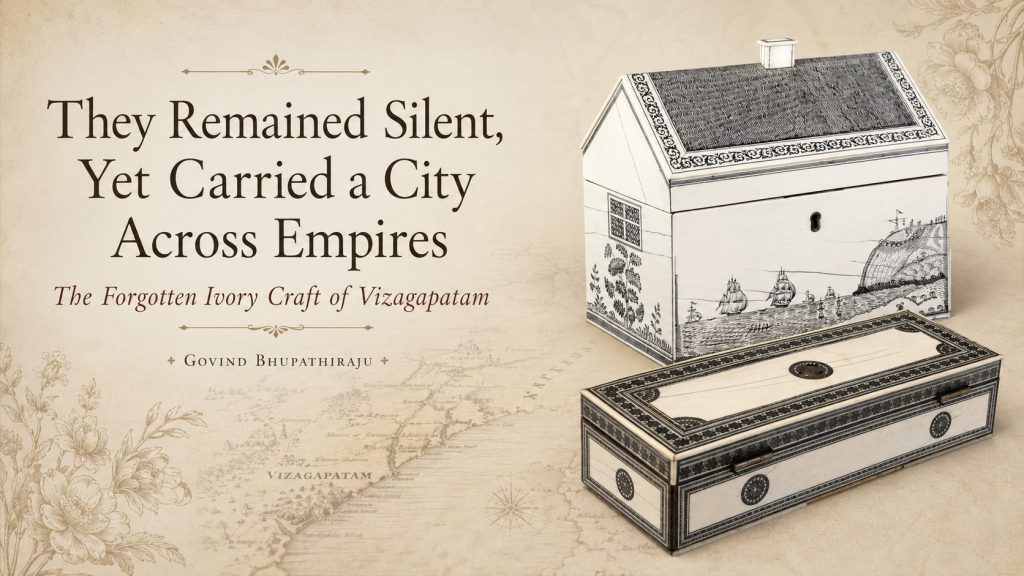
One of the most evocative surviving pieces is a house shaped ivory workbox associated with Vizag. An example modelled as a house, with a seascape across its façade, windows and trees along its sides and back, and a fitted satinwood lined interior. Intriguingly, the catalogue notes that its front panel was reused. 
That small phrase “the front panel reused” opens another mystery.
Was the maritime scene created for an earlier object?
Was it older than the box that eventually carried it?
Did the panel preserve a real landscape, an imagined coastline or a composition copied from a print?
A related image shows sailing ships beneath a steep headland (Dolphin’s Nose). The artisans at Vizag also engraved imagined architecture, foreign scenes and compositions derived from printed sources. Yet the possibility is compelling. An artisan may have engraved the coastline he saw. A box may have left Vizag carrying an image of Vizag upon it.
And two centuries later, the landscape may have become the clue that led the object home at least in memory.
From the workshop to the ship
The furniture did not travel on its own.
Someone chose it.
Someone purchased, commissioned or received it as a gift.
Someone arranged for it to be carried from the workshop to the port, loaded aboard a vessel, protected during the voyage and moved again after arrival.
Ivory furniture often circulated through personal acquisition, private consignments, gifts and the allowances available to Company officers and ship personnel, rather than only as a bulk commercial commodity. That makes the journey intimate.
A small workbox could be packed among personal belongings. A portable cabinet could travel in an officer’s privilege allowance. A larger table or chair might require deliberate freight arrangements and protection from moisture, impact and movement at sea.
Before steamships and container ports, the journey from Vizag to Britain was long, uncertain and physically demanding.
The object passed through surf boats or harbour craft, ships’ holds or cabins, tropical humidity and months at sea.
Its makers may never have travelled beyond the region. Their work did.
The dressing table that reached England by 1761
The Powis Castle dressing table gives us one of the clearest object biographies.
Made in Vizag around 1750, it was in England by 1761. A London upholsterer altered / completed its feet. It was later listed in Robert Clive’s 1774 inventory and eventually moved through family properties before reaching Powis Castle.
Its form therefore records several stages of life:
- Indian construction;
- ivory inlay and engraved crossbanding;
- silver fittings;
- oceanic transport;
- intervention by a London craftsman;
- elite British ownership;
- country-house display;
- modern museum reinterpretation.
The object was not frozen at the moment it left Vizag. It continued to change.
This is important. Museum pieces are often presented as complete and timeless, but many are layered objects. Feet were replaced. stands were added. locks were repaired. interiors were altered. later owners changed how they were described.
An object made in Vizag could acquire a European base.
A cabinet made in India could be placed upon a later English stand.
A suite of Vizagapatam chairs could even lose its identity.
When Vizag became “Spanish”
Here is another extraordinary journey of a suite of ivory inlaid Vizag chairs acquired in Spain by Lionel de Rothschild. Because the furniture had been bought in Spain, later inventories incorrectly identified it as Spanish. The label persisted for decades, even though the workmanship belonged to Vizag. The story reveals how easily an object’s origin can be obscured.
A chair leaves India.
It passes through an Indian or European patron.
It reaches Spain.
It is bought by a British collector.
A household inventory calls it Spanish.
Within a few generations, the place that made it disappears from the record.
Only close study of the ivory inlay, floral patterns, construction and comparative examples restores the original attribution.
The chair had carried Vizag across continents.
But its destination almost erased its birthplace.
From local workshops to royal rooms
The international journey of craftsmanship did not stop at country houses. Ivory inlaid furniture associated with royal collections, including chairs that eventually reached Buckingham Palace.
Alexander Wynch, Governor of Fort St George between 1773 and 1775, commissioned a group of chairs based on an English published model; related pieces entered the Royal Collection.
The route from Vizag workshop to royal room could therefore involve:
- a local or regional patron;
- a Company governor;
- diplomatic gifting;
- purchase in India;
- transport to Britain;
- inheritance or resale;
- eventual royal or museum ownership.
The furniture was admired partly because it seemed familiar and foreign at the same time.
Its shape could resemble English furniture.
Its ornament could evoke Indian textiles, flowers, birds and foliage.
Its workmanship announced a level of precision that collectors valued independently of its origin. Vizag entered elite interiors not as a map location, but as a style.
Who made them? Kamsali artisans of Vizag
Some of the records I went through connects artisans of the Kamsali community to the production of ivory furniture. However Jayshree Ji did mentioned of the Kancharas, a community associated with metalworking and specialised craft production in Vizag. A 1907 Vizagapatam District Gazetteer, states that European patrons employed local craftsmen in ship manufacture, metalware and ivory-inlaid work and connects to Kanchara community and Kancharapalem.
I could understand artisan identities, occupational groupings and local caste names could overlap in complicated ways, and a single finished object may have passed through the hands of several specialists.
One worker may have constructed the wooden carcass.
Another may have prepared the ivory.
Another may have drawn and engraved.
Another may have made the silver or brass fittings.
Another may have polished and assembled the final piece.
The idea of one solitary craftsman producing an entire cabinet may be less accurate than that of a coordinated workshop.
The tragedy is that records rarely preserve those hands individually.
Technical Mastery: Understanding the Craft
Tool and Techniques
The creation of Vizagapatam ivory inlay required a sophisticated array of tools and techniques. Craftsmen used fine saws to cut ivory sheets, specialized gravers for engraving detailed patterns, and various chisels for creating the precise recesses in wooden substrates. The application of lac required heating and careful timing to achieve the desired colors and consistency.
Temperature and humidity control were crucial factors, as ivory is sensitive to environmental conditions. Craftsmen developed techniques for seasoning both wood and ivory to prevent cracking and ensure long-term stability of their creations.
Quality Standards and Variations
Not all Vizagapatam work achieved the same level of excellence. The finest pieces, created for wealthy European clients, featured the thinnest ivory slices, the most intricate patterns, and the most sophisticated use of contrasting materials. Lesser examples, produced for broader markets, might use thicker ivory sections, simpler patterns, or substitute materials like horn or bone for genuine ivory.
The quality of workmanship can be assessed by examining the precision of joints, the fineness of engraved details, and the overall harmony of proportions. Master craftsmen developed personal styles that can sometimes be identified by connoisseurs familiar with the tradition.
Kancharapalem: when a craft survives only as a place name
The history becomes particularly distressing when one looks at modern Vizag. Kancharapalem is now a familiar urban neighbourhood. Its name is spoken daily without necessarily recalling the occupational world from which it emerged. Kancharas who once had a settlement of their own and later moved from traditional craft towards mechanical and industrial work as old patronage systems collapsed. The transition is almost symbolic of Vizag itself. A city known for hand built luxury objects became a city of ports, industries, Container yards, railways, steel, petroleum and heavy industries.
The skills did not entirely vanish. They changed form.
The hands once associated with metal and ivory might later have found work in garages, workshops and factories. Precision survived, but the artistic lineage became harder to see.
The Eastern Art Museum and the survival of memory
The Vizagapatam ivory tradition did not vanish neatly at the end of the eighteenth century.
Eastern Art Museum, founded in the early twentieth century by C. V. Ramana Murthy, whose family was associated with the continuation and preservation of the craft. It mentions artisans working under head craftsmen remembered as Peddayya and Veerachari.
The Eastern Art Museum may represent more than an antique store or workshop.
The box in my cupboard
After reading records, articles, catalogues, it became difficult to look at the box in my own home in the same way. I am not presenting it here as a museum certified object from a known eighteenth-century workshop. But I know it is precious. Its surface preserves a technique, a regional memory and perhaps the fading echo of an artisan tradition that once made Vizag famous far beyond India.
What had once seemed like an old household object became a question.
Who made it?
When?
Was its design engraved and filled with lac in the same way described by Henrietta Clive?
Does its construction resemble documented Vizagapatam boxes?
Was it made for a local family, a princely household, a colonial buyer or a later market?
How many such objects remain unrecognised in Vizag homes?
Some may lie in cupboards.
Some may have been divided among families.
Some may have been sold without their origin being understood.
Some may have been damaged, discarded or dispersed.
The history of Vizagapatam ivory may therefore survive not only in the V&A, Christie’s or the National Trust.
It may survive quietly in the city itself.
A difficult inheritance
Any modern discussion of ivory must acknowledge the material’s history and its cost.
These objects are now culturally important, but they were created from elephant ivory. Modern wildlife protection laws and ethical awareness rightly prohibit the revival of such production using new elephant ivory. Preserving historical objects is not the same as encouraging the ivory trade.
Existing pieces can be studied as evidence of artistic technique, colonial commerce, artisan history and changing relationships between people, materials and wildlife. Their preservation should be accompanied by responsible documentation, secure storage and compliance with applicable laws.
The future of the craft cannot mean repeating the material practices of the past.
Returning Vizagapatam to Vizag
The furniture carries several histories at once.
It is a history of Indian skill.
A history of trade.
A history of patronage.
A history of colonial power.
A history of movement.
A history of collecting.
And, above all, a history of forgetting.
For generations, people in Britain may have sat on Vizagapatam chairs, opened Vizagapatam boxes or displayed Vizagapatam cabinets without knowing much about the city whose name they carried. In Vizag itself, generations grew up without being told that furniture made here had entered and treasured in collections and great country houses.
The objects travelled farther than their makers.
The reputation travelled farther than the memory.
That is why the story must return home.
It should return through museum research, family objects, heritage walks, oral histories, old gazetteers, auction archives and the careful study of surviving craftsmanship.
It should return through Kancharapalem.
Through the Eastern Art Museum.
Through the names Peddayya and Veerachari.
Through the work of researchers such as John Castellas and heritage narrators like Jayshree Hatangadi.
And sometimes, perhaps, through an ivory box sitting unnoticed in a house.
They remained silent
The objects do not tell us what the workshop sounded like.
They do not describe the smell of wood, hot lac or polish.
They do not remember the pressure of the iron point.
They do not name the fingers that fitted one pale strip against another or persuaded ivory to follow a curve.
They do not recall the moment they were wrapped, packed and carried towards the sea.
But they have retained other things.
A flowering tree.
A black line.
A silver handle.
A ship.
A coastline.
They remained silent.
Yet they carried Vizagapatam across empires.
And perhaps it is time for Vizag to recognise what they brought back.
For further reading
- Project MUSE — Production, Purchase, Dispossession, Recirculation: Anglo-Indian Ivory Furniture in the British Country House
- National Trust — Vizagapatam dressing table at Powis Castle
- Christie’s — Late-eighteenth-century Vizagapatam ivory workbox
- Christie’s — Mid-eighteenth-century Vizagapatam ivory-inlaid chairs
- Christie’s — Vizagapatam side chairs with Rothschild provenance
- Victoria and Albert Museum — Glove box
- Museums Victoria — Vizagapatam box
- Brewminate — Anglo-Indian ivory furniture in British country houses
- Times of India — Ivory craft from Vizag adorns royal palace in UK
- Times of India — Kancharas of Vizag are a vanishing tribe