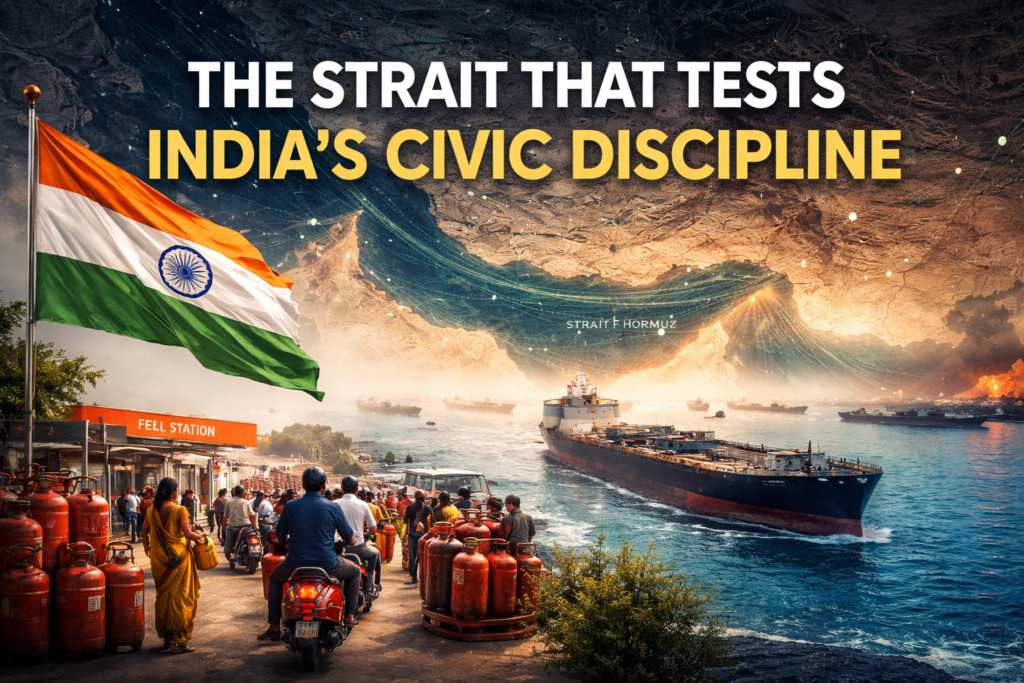
A Crisis near the Strait of Hormuz is never merely a distant geopolitical event. It enters the country quietly, through shipping routes, insurance premiums, energy invoices, freight costs, and household anxieties. What begin as external conflict can, within days, influence how a nation consumes, prices, stores, and reacts. That is why Hormuz is not only a strategic chokepoint on a map, it is a live test of India’s economic steadiness and civic maturity. Though the Government of India, assured that crude supplies remain secure, the situation in West Asia has affected energy flows, especially LPG linked to the Strait of Hormuz.
India’s exposure is real, even if it is being actively managed. Majority of its LPG imports come through the Strait of Hormuz. India did diversified its crude sourcing enough that about 70% of crude imports are now routed outside Hormuz, up from roughly 55% , helping cushion the immediate shock at this crucial election period. It also said refineries are operating at very high utilisation levels and that additional crude and LNG cargoes are already on their way.
Yet the significance of Hormuz extends beyond India’s import basket. As one of the world’s most important oil chokepoints, with around one fifth of global petroleum liquids moving through it and only limited alternatives available if the route is disrupted. The narrow margin of bypass capacity available through regional pipelines in a crisis. That means even when India secures supplies, the wider market can still transmit pressure through prices, shipping schedules, and sentiment.
This is why the present moment should be understood not only as an energy story, but as a civic one. When external conflict disrupts energy flows, the real test of a nation begins at home. In consumption habits, pricing ethics, supply discipline, and civic restraint. A country does not experience stress only when tankers are delayed. It experiences stress when rumours outrun facts, when panic buying distorts normal demand, when sellers exploit uncertainty, and when ordinary prudence gives way to private anxiety.
The government itself has acknowledged the domestic behavioural risk. There are indicated instances of some panic booking and hoarding behaviour in LPG, even though the normal delivery cycle remained around 2.5 days. The government has had to advise consumers not to rush book cylinders, expanded the Delivery Authentication Code system to reduce diversion, increased the minimum booking gap from 21 to 25 days as a temporary demand management measure, and asked states to act against black marketing and hoarding.
That should tell us something important. In moments of supply stress, indiscipline behaves like an accelerant. A shortage feared can become a shortage manufactured when panic outruns need. The person who books prematurely “just in case,” the trader who quietly withholds inventory, the retailer who raises prices overnight, and the distributor who diverts supplies may imagine these as isolated commercial decisions. In aggregate, they weaken national resilience at precisely the moment when steadiness matters most.
This is where patriotism must be understood in practical, not performative, terms. India does not need rhetorical nationalism in an energy sensitive moment nearly as much as it needs operational responsibility. The patriotic citizen is not only the one who speaks loudly of national interest, but the one who conserves fuel, avoids unnecessary stockpiling, and refuses to join a wave of panic. The patriotic business is not only the one that wraps itself in symbolic language, but the one that prices fairly, supplies responsibly, and does not convert public anxiety into private gain.
There is a lesson here for markets as well. Pricing ethics are not a sentimental matter during a disruption, they are part of strategic resilience. If traders hoard LPG cylinders, if intermediaries slow releases to push up margins, or if businesses inflate prices of alternatives such as induction stoves and related appliances purely because fear has entered the market, they are not merely responding to demand. They are aggravating vulnerability. Crisis profiteering is not smart commerce; it is opportunism at a strategically sensitive time.
To India’s credit, the state response has been measured and multi layered. Domestic LPG production had been increased by about 25% by diverting relevant streams into the LPG pool, with the entire domestic output directed towards household consumers. For non-domestic LPG, priority was being given to essential sectors such as hospitals and educational institutions. A three member committee from IOCL, HPCL and BPCL was also set up to review allocations for restaurants, hotels, and other commercial users. In parallel, the Ministry of Ports, Shipping and Waterways said Indian flagged vessels in the Gulf were under continuous monitoring and port operations across India remained stable. At the moment India is still waiting for the vessel Shivalik that is scheduled to berth at Mundra on 16-03-2026. That will be first of the contingent that will be bringing LPG through Strait of Harmuz after Tehran exempted Indian flagged vessels.
These are important buffers, but buffers are not substitutes for civic discipline. Governments can diversify procurement, issue control orders, protect priority sectors, and monitor maritime flows. They cannot, by themselves, manufacture public trust or market ethics. Those must come from within society. National resilience is not built only in ministries, war rooms, or shipping advisories. It is built in kitchens, warehouses, dealerships, booking patterns, and retail counters.
In that sense,
In that sense, this moment also connects naturally with themes I have explored earlier on this website. Here I argued that disorder is no longer an exception in the international system; it is increasingly the operating condition. And in another post Resilience You Can Buy Into, I reflected on how everyday choices often carry larger strategic meaning. This moment brings both themes together. Global instability has arrived, and resilience is no longer an abstract virtue. It must now be practised in the ordinary decisions of households, traders, and institutions.
The Strait of Hormuz, then, does more than threaten supply. It reveals character. It reveals whether a nation can remain calm without becoming complacent, alert without becoming frantic, and patriotic without becoming theatrical. India’s strength in such a moment lies not only in diversifying imports, protecting maritime routes, or stabilising supply chains, necessary though all of these are. It lies equally in whether citizens conserve, whether markets behave, whether businesses resist opportunism, and whether discipline can travel as quickly as fear.
In the years ahead, India will face many such tests some military, some economic, some psychological, and some civic. Not all of them will arrive at the border. Some will arrive through shipping lanes, commodity prices, and the daily choices of ordinary people. That is why civic discipline deserves to be seen not as a minor social virtue, but as an element of national power. A strait far away may disrupt the flow of energy. But what ultimately determines a nation’s resilience is how it conducts itself at home.
In times of disruption, the true measure of patriotism is not volume of sentiment, but steadiness of conduct.