The Missing Luxuries
The sun beat down on the road, and the air carried the familiar mixture of diesel, dust and frying bajji from a roadside cart. Traffic moved in impatient bursts. Horns overlapped. Modern life Two-wheelers slipped through impossible gaps. Somewhere behind me, an auto-rickshaw driver was arguing with a bus conductor.
My phone buzzed.
Another email.
A few seconds later, another message.
Then a notification reminding me about something I had already remembered and was trying hard not to forget.
I was on my way to a meeting, already thinking about the next one, when a peculiar longing entered my mind. It was not a desire for a faster car, a wider road or a cleverer way of avoiding traffic.
It was a desire for something slower.
A quiet afternoon.
A road with no urgency.
A journey in which arriving late did not feel like failure.
There was a time when, sitting by the window of a bus, watching an aircraft disappear into the sky was enough to make us dream. Flying represented progress. It was speed, status and possibility combined. We imagined the day when we too would walk through an airport, carry a boarding pass and look down at the earth from above the clouds.
Today, after flights, airport queues, security checks, hurried boarding calls and tightly packed schedules, I sometimes find myself dreaming of something entirely different.
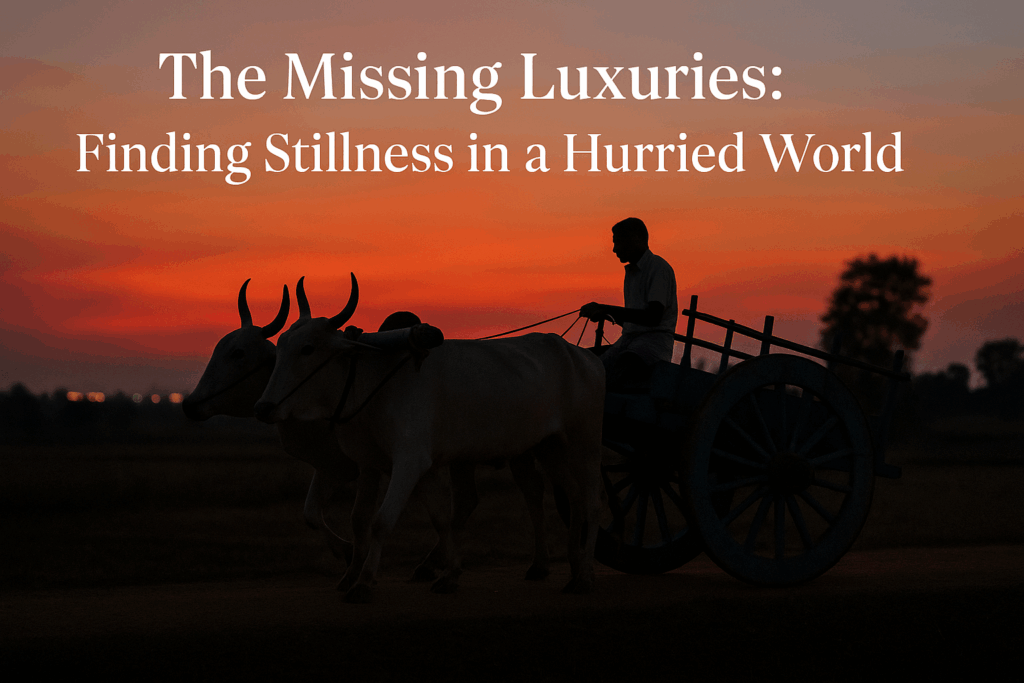
A bullock cart, or the tanga ride that I took from Raxul to Birgunj
No boarding gate. No departure announcement. No impatient queue. No phone signal worth checking.
Only the slow rhythm of wooden wheels, the occasional bell around the animal’s neck, and the wind arriving without air conditioning.
It is a strange reversal.
The things I once wanted to escape from have become the things now wish to return to.
The same reversal has taken place at the dining table.
There was a time when eating at a hotel was an event. It required planning. Children looked forward to it. A restaurant meal was reserved for birthdays, family outings or the rare Sunday when nobody wanted to cook.
The menu itself felt exotic. Soup before dinner was sophistication. Ice cream afterwards was celebration.
Today, restaurants are everywhere. Food can arrive at the door before hunger has fully formed. We can order from five cuisines without leaving the sofa. Yet the meal that increasingly feels like a luxury is the simplest one.
Fresh rice.
Dal.
A vegetable curry.
Pickle.
Perhaps curd at the end.
Food cooked in one’s own kitchen, by someone who knows how much salt we like, whether we prefer the curry a little dry, and which piece of mango pickle we will quietly look for.
We once thought luxury meant eating outside. Now, home cooked food has become a luxury of time, care and presence.
Perhaps that is the larger story of our age. Luxury has not disappeared. It has merely changed its address.
We live in larger homes but meet one another less often. We own faster vehicles but rarely enjoy the journey. We have thousands of photographs but fewer moments we remember without looking at a screen. We can speak to anyone, anywhere, at any time, yet a long and uninterrupted conversation has become increasingly difficult.
We know what an old school friend ate for breakfast in another country. We know which café a stranger visited in Bengaluru. We know the holiday plans of people we have never met.
Yet many of us do not know the names of the neighbours living two doors away.
Technology has widened our world, but it has not necessarily deepened it.
The real scarcity today is not information. It is attention.
Not connectivity, but connection.
Not entertainment, but rest.
Not food, but nourishment.
Not movement, but meaning.
Perhaps the greatest luxury we have lost is unhurried time. Not more hours in the day, but the feeling that a moment does not have to be used for anything.
An afternoon that is not productive.
A walk that is not exercise.
A conversation that has no agenda.
A journey that does not need to be shortened.
We have become so accustomed to measuring time that we have forgotten how to inhabit it. Every hour must justify itself. Every activity must lead somewhere. Even rest has become something to optimise.
We use applications to sleep better, watches to tell us whether we have walked enough, and reminders to pause and breathe.
There is something both impressive and tragic about needing technology to remind us to be human.
Thousands of years before calendars became crowded and notifications became constant, the Isha Upanishad spoke of the divine presence in everything that moves in this moving world. Such an idea cannot be understood in a hurry. It requires a certain stillness, a willingness to observe without immediately moving on.
But stillness now makes us uncomfortable.
At a traffic signal, we reach for the phone.
In a lift, we check messages.
While waiting for food, we scroll.
Even silence is treated like an empty space that must be filled.
The result is that our bodies may be in one place, while our attention is permanently elsewhere.
The Katha Upanishad speaks of the Self dwelling within the heart, subtle and difficult to perceive. To discover anything within, however, one must first reduce the noise outside.
That is becoming harder.
We are surrounded by voices telling us what to buy, where to travel, what to admire, whom to follow and how quickly we are falling behind. The world enters our minds before we have had a chance to meet ourselves.
Perhaps this is why solitude, once feared, is now sought after in expensive retreats. Silence, once freely available, is sold as a wellness experience. Rural life, once dismissed as backward, is repackaged as slow living. Millets return as superfoods. Clay cups return as sustainability. Courtyard houses return as architectural wisdom.
We often abandon something in the name of progress, only to rediscover it later under a fashionable name.
The Bhagavad Gita offers another reminder that feels particularly relevant to our hurried lives: we have a right to action, but not to its fruits.
This is not an argument against ambition. It is an argument against allowing outcomes to consume the entire experience of living.
Modern life is built around the next result.
The next promotion.
The next purchase.
The next milestone.
The next version of ourselves.
We tell ourselves that contentment will arrive after one more achievement. But each destination quickly becomes another departure point.
We reach, and immediately begin running again.
Perhaps that is why the bullock cart appears so attractive in imagination. It is not because we want to abandon progress. Few of us truly want to give up modern medicine, reliable transport, electricity or communication.
The yearning is not for hardship.
It is for balance.
The bullock cart represents a pace at which the mind and body can travel together.
In our present lives, the body often reaches the destination before the mind has left the previous one.
Every generation spends its youth chasing the luxuries its parents never had. Then, somewhere in the middle of life, it begins longing for the ordinary things its parents never lost.
A full night’s sleep.
A meal with the family.
Children playing outside.
A phone that does not ring.
A weekend without work.
A visit without an appointment.
A morning with nowhere to go.
These things cost very little, yet they have become increasingly difficult to afford.
As children, we imagined luxury as abundance. More choices, more speed, more comfort, more access.
With age, perhaps we begin to understand luxury differently.
Enough time.
Enough health.
Enough quiet.
Enough companionship.
Enough clarity to know when enough is enough.
The smell of rain on dry earth, a mango eaten directly from the tree, a grandmother’s story repeated for the tenth time, the sound of vessels in the kitchen before lunch—none of these appeared luxurious when they were part of ordinary life.
Only after they began disappearing did we understand their value.
That may be the sadness of human experience. We recognise many blessings only in retrospect.
Perhaps progress was never the problem.
Perhaps speed was never the enemy.
Somewhere along the way, we may simply have forgotten why we started running.
We chased convenience until convenience replaced experience. We chased efficiency until efficiency replaced presence. We chased success until success quietly occupied the space where contentment once lived.
And so, after spending childhood dreaming of flights, we now dream of bullock carts.
After spending years longing to eat in restaurants, we now yearn for food from our own kitchens.
Life, it seems, has a quiet sense of irony. The greatest luxuries are rarely the ones we acquire. They are often the ordinary things we once had in abundance and were too busy growing up to recognise.